


TL;DR:
- Small service businesses often mistake SaaS SEO for regular SEO, missing out on the unique strategies needed to generate qualified leads. SaaS SEO focuses on product-led content, technical platform constraints, and recurring content cycles that adapt to ongoing search landscape shifts, especially with AI-driven answer engines. Prioritizing high-intent, low-competition pages, technical optimization, and structured content positioning can significantly improve lead quality and conversion rates.
Most small service businesses assume SaaS SEO is just regular SEO with a fancier tool behind it. That assumption is costing them real revenue. SaaS SEO operates on a completely different logic, one built around recurring subscriptions, product-led content, and buyer journeys that stretch across weeks or months. If you run a cleaning company, HVAC business, landscaping operation, or any other service-focused brand, understanding this distinction isn’t just academic. It’s the difference between generating qualified leads and generating traffic that never converts.
Key Takeaways
| Point | Details |
|---|---|
| SaaS SEO is unique | It’s not the same as traditional SEO—it requires its own approach for service businesses. |
| Hybrid SEO and AEO | Success after 2025 demands blending traditional SEO with answer engine strategies for full visibility. |
| Focus on intent | Targeting specific, high-intent keywords works better than chasing search volume for SaaS success. |
| Test for overlap | Avoid undermining your own efforts by testing and preventing content cannibalization regularly. |
| BOFU content wins | Bottom-of-funnel pages convert best, so prioritize content that solves ready-to-buy needs. |
SaaS SEO explained: The basics and why it matters
Now that we’ve set the stage for why SaaS SEO is confusing, let’s break down exactly what it means and why it matters.
SaaS SEO refers to search engine optimization strategies tailored specifically for Software as a Service platforms and the businesses that use them to manage their digital presence. It’s not simply “doing SEO on a software site.” SaaS SEO incorporates how the platform itself functions, how its content infrastructure supports rankings, how integrations feed data back into your strategy, and how each content piece moves a potential customer from awareness to conversion.
For small service businesses, SaaS platforms like service management software, CRM tools, booking systems, and website builders often serve as the backbone of their online presence. The SEO you build on top of these platforms has to account for how those tools handle technical performance, crawlability, and content publishing. A scheduling platform built for plumbers handles SEO differently than a custom-coded WordPress site, and those differences matter a great deal.
Here are the core elements that define SaaS-specific SEO:
- Content infrastructure: Blog templates, landing pages, and product pages built within SaaS tools often have constraints on metadata, URL structure, and schema markup
- Technical SEO limits and strengths: SaaS platforms may auto-generate sitemaps or handle redirects differently, which affects how search engines crawl your site
- Platform integrations: Tools like Google Search Console, Analytics 4, and third-party review platforms connect differently through SaaS than through self-hosted solutions
- Analytics and intent data: SaaS dashboards often surface engagement rate, dwell time, and conversion data that should directly inform your keyword and content decisions
- Recurring content cycles: SaaS SEO is ongoing, not a one-time project, because the platform and search landscape both evolve continuously
Staying current with these elements matters more than ever. As hybrid SEO and AEO become essential after AI-driven search shifts, treating SaaS SEO as a static checklist is no longer viable. Answer Engine Optimization, which means structuring content so AI tools and search engines can surface direct answers, is now a required layer alongside traditional optimization.
If you want a solid foundation to build from, exploring SaaS SEO strategies tailored to service businesses is a smart starting point.
SaaS SEO vs. traditional SEO: Key differences that impact your service business
With the basics in place, let’s look at how SaaS SEO fundamentally differs from the traditional SEO approach most service businesses know.
Traditional SEO focuses heavily on on-page optimization, link building, and keyword targeting for static or semi-static websites. SaaS SEO, by contrast, is shaped by product-led content, subscription logic, and platform constraints that change how you approach nearly every tactic.

| Feature | Traditional SEO | SaaS SEO |
|---|---|---|
| Content focus | Informational and local | Product-led, feature-specific, BOFU |
| Technical control | Full (self-hosted) | Platform-dependent |
| Keyword strategy | Volume-driven | Intent-driven, low-KD priority |
| Analytics | Manual setup | Often built-in or semi-automated |
| Update cycles | On demand | Platform-schedule dependent |
| Buyer journey alignment | General funnel | Recurring, subscription-aware funnel |
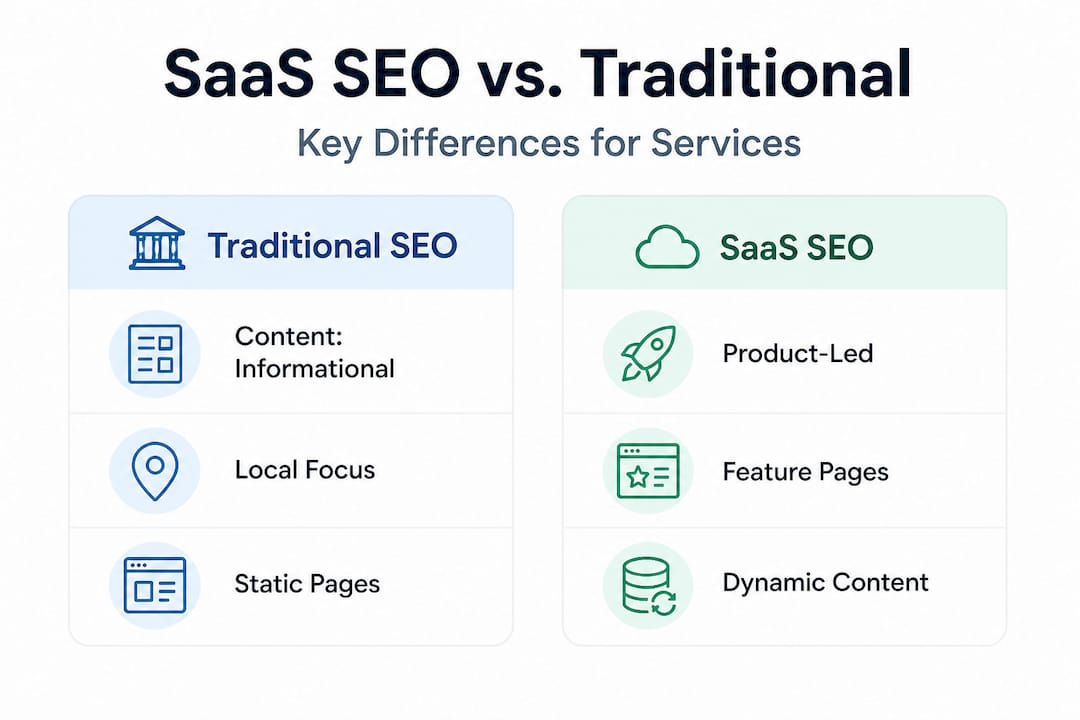
The table above shows why swapping your traditional SEO playbook into a SaaS environment creates friction. A roofing company that ranks well on a custom site may struggle when it migrates to a SaaS platform because the platform’s URL structure or template limitations undo previous SEO gains.
Here are common mistakes service businesses make when applying traditional SEO logic to a SaaS context:
- Chasing high-volume keywords that don’t convert: A keyword like “HVAC tips” may have 10,000 monthly searches, but low-KD high-intent keywords like “emergency HVAC repair near me tonight” drive actual service calls
- Ignoring platform technical constraints: Assuming your SaaS tool handles canonical tags, structured data, or page speed the same way a custom site does
- Creating content that competes with itself: Publishing multiple similar service pages without checking for keyword overlap leads to cannibalization, where your own pages outcompete each other and weaken both
- Skipping integration audits: Failing to connect your booking or CRM data to your SEO analytics means you’re optimizing blind
- Treating SEO as a setup task: SaaS platforms update frequently, and those updates can affect your site’s SEO structure without warning
Understanding SEO in service industries helps clarify which of these pitfalls is most likely to hit your specific business type. Landscapers face different keyword competition than dentists, even when both use similar SaaS platforms.
Pro Tip: Before creating new content on your SaaS platform, map your existing pages against your target keywords. If two pages already target the same intent, consolidate them rather than publish a third. This protects your rankings and sharpens your authority on that topic.
Staying on top of the 2026 SEO ranking factors for services will also help you prioritize where your SaaS SEO energy goes, especially as ranking signals continue shifting toward user experience and structured content.
How AI and AEO are changing SaaS SEO after 2025
Once you understand the foundation of SaaS SEO, the next evolution is how artificial intelligence and AEO are rewriting the rules for everyone, especially after 2025.
AEO, or Answer Engine Optimization, means structuring your content so that AI-powered search tools like ChatGPT, Google’s AI Overviews, and other large language model (LLM) based engines can surface it as a direct answer to a user’s question. This is not the same as traditional keyword optimization. It requires clear formatting, concise answers to specific questions, and content that demonstrates authority in a format these engines can parse easily.
Here’s why this matters for your service business: 94% of B2B buyers now use LLMs during their software research journey. Even if your business is B2C, the behavioral shift is the same. Buyers ask AI tools for recommendations before they ever visit a search results page. If your content isn’t structured to appear in those AI responses, you lose visibility at the awareness stage entirely.
| Buyer journey stage | Pre-2025 behavior | Post-2025 behavior |
|---|---|---|
| Awareness | Google search, organic results | LLM query, AI overview |
| Consideration | Review sites, blog posts | AI-generated comparison answers |
| Decision (BOFU) | Service page, contact form | SEO-captured conversion page |
| Retention | Email, remarketing | Platform-integrated touchpoints |
The table above makes one thing very clear: SEO captures BOFU conversions even in an AI-first world. The decision stage, where someone is ready to hire a plumber, book a cleaning, or sign with a contractor, still runs through traditional search and landing pages. That’s where your SaaS SEO investment pays off most directly.
To stay visible after these shifts, your content strategy needs to include these new success factors:
- Direct answer formatting: Use FAQ sections, numbered steps, and short definitions that LLMs can extract and cite
- Clear entity signals: Name your business, services, and location explicitly so AI engines can categorize you accurately
- Structured data markup: Schema for services, reviews, and FAQs tells search engines exactly what your content covers
- Content depth over content volume: A single thorough page about “residential carpet cleaning in Austin” outperforms five thin pages targeting similar terms
- LLM visibility testing: Regularly query AI tools with your target questions to see if your content surfaces, and adjust accordingly
The future of SEO is not about abandoning what works. It’s about layering AEO intelligence on top of a solid SaaS SEO foundation so you capture buyers at every stage of their decision journey.
Actionable steps: Optimize your SaaS SEO for the service industry
Understanding the shifts isn’t enough. You need actionable steps you can execute today as a small business owner in the service industry.
The following roadmap is designed for businesses operating within SaaS platforms, whether that’s a website builder, CRM with a web presence, or a field service management tool with a public-facing site.
Audit your platform’s technical SEO capabilities. Log into your SaaS tool and check what control you have over metadata, URL slugs, canonical tags, and sitemap generation. Document any gaps where the platform limits your optimization options.
Build a focused keyword map around high-intent, low-competition terms. Instead of targeting “house cleaning services” (high volume, brutal competition), go after “move-out cleaning service in [your city]” or “deep cleaning for rental properties.” These terms signal clear buying intent and are far more winnable.
Create or update your bottom-of-funnel pages first. Your service pages, pricing pages, and location pages convert. These need to be technically clean, rich with trust signals (reviews, credentials, photos), and structured with schema markup before you invest in blog content.
Structure all content for AEO. Every page should answer at least one specific question in the first 100 words. Use subheadings as questions. Include a FAQ section. This improves both traditional rankings and LLM visibility.
Connect your analytics properly. Link Google Search Console and Analytics 4 to your SaaS platform. Track which pages generate actual leads or calls, not just clicks. Engagement rate and conversion data should drive your next content decisions.
Test for keyword cannibalization every quarter. If two of your pages compete for the same search intent, test empirically for cannibalization by checking which page Google ranks more consistently, then consolidate or differentiate them with clear, distinct intent angles.
Build internal links between your service pages. A page about “roof inspection services” should link naturally to “roof repair estimates” and “emergency roof patching.” This creates topical authority clusters that help search engines understand your full service offering.
Pro Tip: Use Google Search Console’s “Pages” report to find which URLs are getting impressions but low clicks. These pages already have some visibility and are often quick wins. Update their title tags and meta descriptions to better match the actual search query, and watch your click-through rate improve within a few weeks.
For a structured workflow you can follow consistently, the SEO workflow for service businesses breaks down each phase from research to publishing to monitoring in practical terms built for service industry owners.
The uncomfortable truth about SaaS SEO for small businesses in 2026
Now, let’s get real about what most guides won’t say. Here’s the uncomfortable truth you need to hear.
Most SaaS SEO guides are written for enterprise software companies with six-figure content budgets. When small service businesses follow those playbooks, they end up publishing 50 blog posts targeting keywords they’ll never rank for, while ignoring the five service pages that actually drive calls. That’s not a strategy problem. That’s a perspective problem.
I’ve worked with enough local service businesses to see a clear pattern: the ones that grow fastest aren’t the ones following the most sophisticated playbooks. They’re the ones who stop trying to look like the big SaaS companies and start optimizing for the specific, narrow intent of their actual buyers.
Here’s what that looks like in practice. A landscaping company in Phoenix doesn’t need a content strategy targeting “how to design a backyard.” They need a page that ranks for “desert landscaping contractors Phoenix” with reviews, photos, and a clear call to action. That single page, optimized correctly, generates more revenue than a dozen informational posts ever will.
The advanced SaaS SEO strategies that actually work for small service businesses share one common thread: they prioritize low-volume, high-intent, BOFU content over broad traffic. It sounds counterintuitive. Less traffic, more conversions. But when you’re a solo contractor or a 10-person cleaning company, one qualified lead beats 500 curious visitors every time.
The other mindset shift I’d push you toward is this: stop copying your competitors’ content and start testing empirically for cannibalization and what actually ranks in your specific market. What works for a plumber in Dallas may not work for one in Denver. Your market has its own search behavior, its own competition density, and its own AEO gaps you can fill. Run the experiment. Check the data. Build what your buyers are actually searching for.
Need help mastering SaaS SEO? Boost your results with expert support
Ready to put these insights to work? Here’s how you can go further with tailored support.
SaaS SEO for service businesses is not a one-size-fits-all challenge. Whether you run a dental practice, a roofing company, or a moving service, the combination of platform constraints, local search dynamics, and post-2025 AI shifts creates a strategy problem that requires specific expertise to solve.
If you’re ready to move beyond guesswork and build an SEO approach that actually generates leads, we can help. Our resources for SEO for small businesses cover the strategies that work across service industries, from keyword research to technical audits to content planning. You can also review the important SEO ranking factors that matter most for service-based sites in 2026 so you know exactly where to focus your energy. The right guidance cuts through the noise and gets you results faster.
Frequently asked questions
How does SaaS SEO support lead generation for service businesses?
SaaS SEO targets high-intent searches with strategic content and features that drive more qualified leads from search engines. Because SaaS SEO captures BOFU conversions directly, service businesses see stronger lead quality rather than just higher traffic numbers.
What are the main SEO traps service businesses should avoid when using SaaS?
Avoid focusing on high-volume, low-intent keywords and make sure not to create content that competes with your own pages. Focusing on low-KD high-intent terms and testing for cannibalization are two of the highest-impact protective moves you can make.
How do AI and answer engines impact SaaS SEO strategies in 2026?
AI and answer engine optimization mean you must structure content for better direct answers, as 94% of B2B buyers use LLMs in their research journey. Service businesses that format their pages with clear answers, schema markup, and FAQ sections gain visibility in both traditional and AI-driven search results.
What content should small service businesses prioritize in their SaaS SEO?
Focus on bottom-of-funnel pages and content that addresses specific service needs for higher conversion rates. SEO captures BOFU conversions most reliably, so your service, pricing, and location pages should always be optimized before broader informational content.