


TL;DR:
- Google Maps ranking depends on relevance, distance, and prominence, affecting how visible your business is locally. Keeping your profile complete, collecting recent reviews, and ensuring citation consistency help improve your position, which is essential given the high local search intent. Rankings fluctuate regularly, requiring ongoing management and monitoring for sustained visibility.
Google Maps ranking is the algorithmic position your business occupies in Google Maps local search results, determined by three core factors: relevance, distance, and prominence. For small service businesses, this position is not a vanity metric. 46% of all Google searches carry local intent, meaning nearly half of all searches are from people ready to hire or buy nearby. Businesses that understand what is Google Maps ranking and act on it gain a direct line to those customers before competitors do.
What are the main Google Maps ranking factors?
Google Maps local search ranking, formally called the Google Local Pack algorithm, weighs three signals simultaneously. No single signal guarantees a top position. Google’s algorithm combines relevance, distance, and prominence in weighted ways that shift with every search query.

Relevance measures how well your Google Business Profile matches what someone searched. A plumber whose profile lists “emergency pipe repair” will rank for that phrase. A plumber whose profile only says “plumbing services” will not. Keyword alignment inside your business description, services, and category selection all feed this signal.
Distance measures how close your business is to the searcher or to the location named in the query. A cleaning company in downtown Chicago ranks higher for “cleaning service Chicago Loop” than one located in the suburbs. Proximity is partially outside your control, but your listed address and service area settings directly affect how Google calculates it.
Prominence is the reputation signal. It pulls from Google reviews, third-party citations, backlinks to your website, and your overall authority in local directories. A roofing company with 200 reviews, consistent citations on Yelp and Angi, and a well-linked website will outrank a competitor with a bare profile.
- Relevance: driven by category selection, keywords in your profile, and service descriptions
- Distance: tied to your physical address and the searcher’s location at the time of the query
- Prominence: built through reviews, citations, backlinks, and brand mentions across the web
- All three factors interact. Strong prominence can partially offset a distance disadvantage.
Pro Tip: Fill out every field in your Google Business Profile, including services, business description, and attributes. Google uses all of it to determine relevance.
How do customer reviews influence your Google Maps ranking?
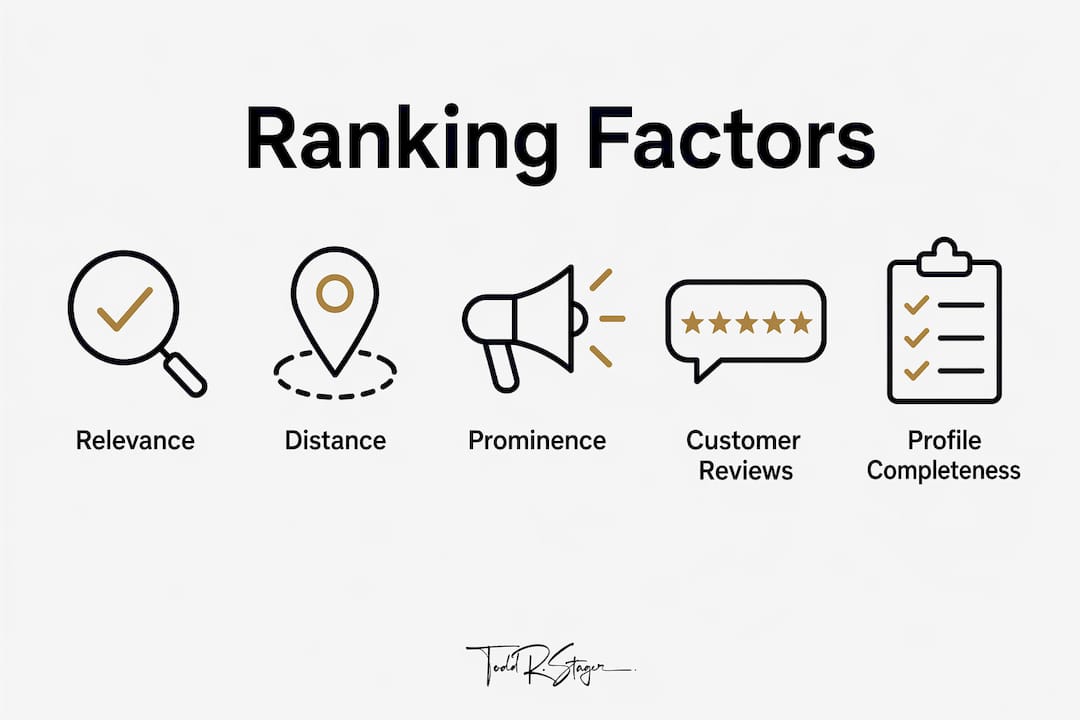
Reviews are the most visible part of prominence, and they carry more nuance than most business owners realize. The total number of reviews matters less than most people think. Review velocity, meaning how recently and consistently you collect reviews, often outweighs raw volume.
Google interprets stale reviews as a signal that a business may have declined in quality or even closed. A HVAC company with 80 reviews collected over the past six months can outrank a competitor with 200 reviews that stopped coming in two years ago. Freshness signals active, ongoing customer engagement.
Rating thresholds matter too. Ratings below 3.9 stars significantly reduce visibility in local results. The sweet spot for sustained ranking is 4.2 stars and above. Falling below 3.9 does not just hurt your reputation with customers. It actively suppresses your algorithmic position.
Responding to reviews is a direct ranking input. Responding to about 90% of reviews within 48 hours signals active management and positively impacts prominence. Here is a practical sequence for managing reviews:
- Ask every satisfied customer for a review within 24 hours of service completion.
- Respond to every review, positive or negative, within 48 hours.
- Address negative reviews professionally and offer to resolve the issue offline.
- Track your review velocity monthly. If new reviews slow down, restart your outreach.
- Never incentivize reviews with discounts or gifts. Google’s policies prohibit it and the risk is not worth it.
Pro Tip: Add a review request to your post-service follow-up text or email. A direct link to your Google Business Profile review page removes friction and increases completion rates.
The real role of reviews in local SEO goes beyond star ratings. Keyword-rich review text, where customers mention your service type and city, reinforces your relevance signal at the same time.
Optimizing your Google Business Profile for better ranking
Profile completeness is the fastest lever most service businesses have not pulled. Complete business profiles on Google get 7 times more clicks than incomplete ones. That gap is enormous, and most businesses leave it on the table.
Correct primary category is the single most important relevance factor in your entire profile. A therapist who selects “Counselor” instead of “Mental Health Clinic” or “Psychotherapist” will miss searches that use those terms. Choose the category that most precisely describes your core service, then add secondary categories for related services you offer.
| Profile Element | Weak Version | Strong Version |
|---|---|---|
| Primary category | “Professional Services” | “Plumber” or “HVAC Contractor” |
| Business description | “We offer quality services” | 750-character description with city, service types, and differentiators |
| Services section | Left blank | Every service listed with individual descriptions |
| Attributes | None selected | Accessibility, payment options, service area marked |
| Photos | 1 stock image | 10+ real photos of team, work, and location |
Attributes specific to service categories, such as accessibility features and service options, improve relevance for particular queries. A cleaning business that marks “online booking available” and “serves residential clients” captures more specific searches.
Consistent NAP (name, address, phone) across directories is a prominence signal that many businesses underestimate. Inconsistent citations create doubt about your business’s accuracy and hurt ranking. Your name, address, and phone must match exactly on Google, Yelp, Angi, the Better Business Bureau, and your own website. Even small differences like “St.” versus “Street” create signal noise.
Your website reinforces your Google Business Profile. Local landing pages that mention your city, service type, and neighborhood give Google additional confirmation that your profile data is accurate. This is where service area SEO tactics become critical for businesses that serve multiple zip codes.
Common misconceptions about how Google Maps ranking works
The most damaging myth in local SEO is that you can pay Google for a higher Maps position. Google explicitly states it does not allow businesses to pay for higher local rankings. Paid Google Ads can appear above the local pack, but the organic map positions are determined entirely by algorithm. Any service claiming to sell you a guaranteed Maps ranking is selling something Google does not offer.
The second major misconception is that rankings are fixed. Google Maps ranking fluctuates dynamically based on search query, the searcher’s location, and even the time of day. A landscaping company might rank first for “lawn care” at 9 a.m. on a Saturday and third for the same term at 2 p.m. on a Tuesday. Rankings are a moving target, not a permanent achievement.
- Rankings shift with every search. What you see when you check your own listing is not what every customer sees.
- Proximity is real but partial. A business two miles away does not automatically beat one five miles away if the closer one has a weaker profile.
- Google favors businesses with a physical address in the searched city that are open at the time of the query. Keeping your hours accurate and current is a direct ranking input.
- Secondary signals like post frequency, Q&A responses, and photo uploads feed into relevance and prominence over time.
“Continuous management and fresh engagement are vital for sustained visibility on Google Maps.” The businesses that treat their Google Business Profile as a living asset, not a one-time setup, consistently outperform those that set it and forget it.
Step-by-step strategy to improve your Google Maps ranking
Improving your Google Maps visibility follows a clear sequence. Skipping steps creates gaps that undermine the ones you do complete.
- Audit or set up your Google Business Profile. Claim your listing if you have not. Verify your address. Fill every field completely, including hours, services, description, and attributes.
- Select the right primary category. Research which category your top-ranking local competitors use. Match or refine it to your most specific service type.
- Build a review generation system. Ask every customer for a review immediately after service. Use a direct link to your review page. Respond to every review within 48 hours.
- Audit your citations. Search your business name on Google and check Yelp, Angi, and the Better Business Bureau. Correct any inconsistencies in your name, address, or phone number.
- Optimize your website for local keywords. Create service pages that name your city and service type together. Add your address to your website footer. Embed a Google Map on your contact page.
- Monitor your ranking monthly. Use Google Business Profile Insights to track search queries, views, and customer actions. Adjust your profile and content based on what is driving clicks.
Pro Tip: Use the Google Business Profile “Update” posts feature weekly. Fresh posts signal active management and give Google additional keyword signals tied to your services.
A complete local SEO checklist covers every element of this process in detail, from profile setup through citation building and website optimization. Working through it systematically is the most reliable path to sustained ranking improvement.
Key Takeaways
Google Maps ranking is determined by relevance, distance, and prominence working together, and consistent profile management is the most reliable path to sustained local visibility.
| Point | Details |
|---|---|
| Three core ranking factors | Relevance, distance, and prominence all interact. No single factor guarantees top placement. |
| Review velocity beats volume | 80 recent reviews outrank 200 old ones. Collect reviews consistently, not in bursts. |
| Profile completeness drives clicks | Complete Google Business Profiles receive 7 times more clicks than incomplete ones. |
| No paid Maps ranking exists | Google does not sell local pack positions. Organic signals are the only path to ranking. |
| Rankings are dynamic | Your position shifts with query, location, and time of day. Monthly monitoring is non-negotiable. |
What I’ve learned after years of watching Google Maps rankings move
I’ve worked with service businesses across dozens of industries, from HVAC contractors to therapists to cleaning companies. The pattern I see most often is this: a business owner sets up their Google Business Profile once, gets a decent initial ranking, and then watches it slowly erode over six to twelve months. They assume Google changed something. Usually, a competitor just kept working while they stopped.
The businesses that hold strong rankings share one habit. They treat their Google Business Profile the way they treat their best employee: with regular attention, clear direction, and accountability. They post updates. They respond to every review. They fix their hours when they change. They add new service photos after completing notable jobs.
I’ve also seen the damage that shortcuts cause. Buying fake reviews, keyword-stuffing business names, and using virtual office addresses to fake proximity all carry real penalty risk. Google’s quality guidelines are enforced, and a suspended listing is far more damaging than a mediocre ranking.
The honest truth about competing with larger businesses on Google Maps is that size does not win. Recency and completeness win. A solo plumber with 60 fresh reviews, a complete profile, and consistent citations will outrank a regional chain with 400 old reviews and a neglected listing. That is genuinely good news for small service businesses willing to put in the work.
The SEO strategies built for service industries are not complicated. They are consistent. Start there, and the ranking follows.
— TODD
How Toddstager helps service businesses rank on Google Maps
Ranking consistently on Google Maps requires more than a one-time profile setup. It requires ongoing citation management, review strategy, and website optimization working together.

Toddstager specializes in local SEO for service businesses, from plumbers and HVAC contractors to dentists, landscapers, and real estate agents. The approach is built around the same ranking factors covered in this article: profile completeness, review velocity, citation consistency, and local keyword alignment. If your Google Maps visibility has plateaued or you are starting from scratch, Toddstager’s team builds the foundation that produces measurable, lasting results in local search.
FAQ
What is Google Maps ranking?
Google Maps ranking is the position your business appears in local search results on Google Maps, determined by relevance, distance, and prominence. Higher positions generate significantly more clicks and customer inquiries.
What affects Google Maps ranking the most?
The correct primary category is the single most important relevance factor, while review velocity and citation consistency drive prominence. All three core factors interact, so no single element alone controls your position.
Can you pay Google to rank higher on Google Maps?
No. Google explicitly does not allow businesses to pay for higher local rankings in Google Maps. Organic signals like profile completeness, reviews, and citations are the only factors that determine placement.
How many reviews do I need to rank well on Google Maps?
Review velocity matters more than total count. A business with 80 recent reviews collected over six months can outrank one with 200 reviews that stopped accumulating two years ago. Aim for a steady, consistent flow rather than a one-time burst.
How often does Google Maps ranking change?
Google Maps rankings shift dynamically based on the search query, the searcher’s physical location, and the time of day. Monthly monitoring through Google Business Profile Insights gives you the clearest picture of your actual performance trends.