


TL;DR:
- Most CPAs excel in their field but remain invisible online, making SEO crucial for attracting high-intent local clients. Effective SEO involves optimizing service pages, Google Business Profiles, and acquiring reviews to improve visibility and trust, especially in AI-driven search where clarity and specificity are vital. Regularly measuring organic traffic, rankings, and conversions guides continuous improvement, ensuring firms remain competitive and relevant in the digital age.
Most CPAs are exceptional at what they do but invisible online. That gap between expertise and discoverability is exactly where the role of SEO for CPAs becomes critical. Search engine optimization is no longer just a marketing checkbox. It determines whether a prospective client finds your firm or your competitor’s when they type “tax preparation services near me” at 11 p.m. during a financial crisis. This guide breaks down what SEO actually means for accounting professionals in 2026, how AI-driven search is changing the rules, and which strategies move the needle on qualified client acquisition.
Key takeaways
| Point | Details |
|---|---|
| SEO captures high-intent leads | Appearing for searches like “CPA near me” connects your firm with prospects ready to hire. |
| Local SEO is non-negotiable | Optimizing your Google Business Profile drives visibility for geographic searches that dominate accounting queries. |
| AI search rewards clarity | Firms that communicate services clearly and consistently are more likely to be selected by AI-powered search tools. |
| Content and technical health work together | Quality service pages paired with fast, mobile-friendly sites build both rankings and user trust. |
| Track conversions, not just rankings | Measuring how organic traffic turns into client inquiries reveals SEO’s real business impact. |
The role of SEO for CPAs, explained
Search engine optimization is the practice of making your firm’s website visible and credible to search engines like Google so the right people find you at the right moment. For CPAs, that moment is when a small business owner searches “QuickBooks cleanup accountant” or a family searches “estate tax CPA” before a major financial decision.

Matching your services to specific search terms like “CPA near me” is what drives qualified leads rather than random site traffic. The distinction matters. Generic visibility gets you clicks from people browsing. Intent-matched visibility gets you calls from people ready to hire.
Here is what the SEO foundation looks like for a CPA firm:
- Google Business Profile: Your listing needs accurate hours, service categories, a geo-tagged location, and recent client reviews. Most local accounting searches surface map results first, and local citations increase trust with both search engines and prospects.
- Technical health: Google uses mobile-first indexing, meaning it evaluates your site the way a smartphone would. Poor technical SEO health — slow load times, broken links, or unreadable mobile layouts — directly hurts rankings and pushes potential clients away before they ever read your bio.
- Service pages: Each service you offer (tax preparation, bookkeeping, business advisory) deserves its own page built around the terms people actually search.
- On-page signals: Title tags, meta descriptions, headers, and internal links all tell search engines what each page is about and who it serves.
Pro Tip: Don’t wait until tax season to optimize your Google Business Profile. Update it quarterly with fresh photos, responses to reviews, and posts about your services. Google treats activity as a trust signal.
SEO strategies that match your expertise
Knowing SEO exists is not enough. The real SEO impact on accounting firms comes from executing the right strategies in the right order. Here is a practical sequence that works:
Build authoritative service pages. Think of each service page as the source of truth for that topic. A page on “small business tax preparation” should answer what you do, who you serve, what the process looks like, and what clients should expect. Linking educational content to these pages creates keyword clusters that both search engines and AI systems trust.
Create educational content clients are already searching for. Blog posts and FAQ pages answering questions like “What can I deduct as a freelancer?” or “Do I need a CPA or a bookkeeper?” attract readers early in their decision process and position your firm as the obvious next step.
Do keyword research with buyer intent in mind. Broad terms like “accounting” have massive competition and low conversion rates. Specific phrases like “forensic accountant for divorce proceedings” or “S-corp election CPA Chicago” reflect real buying intent and connect with clients who need exactly what you offer. Tools like Google Search Console reveal which queries already bring traffic to your site.
Add schema markup. This is structured data code that tells Google your page is a service, a review, or a FAQ. It improves how your listing appears in search results, sometimes showing star ratings or direct answers below your link. More visual real estate in search results means higher click-through rates.
Manage online reviews actively. Trust signals like reviews and professional bios are not soft marketing. They contribute directly to search rankings and conversion rates. Accounting is a trust-based service, and a firm with 40 recent five-star reviews will consistently outperform a technically superior firm with three outdated ones.
Pro Tip: Ask clients for Google reviews immediately after a successful engagement while the experience is fresh. A simple email with a direct review link removes friction and increases follow-through dramatically.
You can find more tactics specifically built for accounting firms in this guide to SEO strategies for accountants that covers positioning and competitive differentiation.
AI search and what it means for your firm
A lot of CPAs have heard that AI is “changing SEO” and assumed that means their current SEO efforts are obsolete. That assumption is wrong, but the nuance matters.
Google’s generative AI search features do not replace traditional SEO quality signals. They build on them. Google’s own guidance confirms that its AI features rely on the same ranking and quality algorithms that have always determined search results. So the firms that have invested in strong content, technical health, and authoritative service pages are already positioned well for AI-driven results.
“Optimizing for generative AI search is not a separate practice but an extension of strong SEO fundamentals that focus on user intent and quality.”
What is changing is the selection dynamic. When someone asks an AI assistant “Who is the best CPA for small business taxes in Denver?”, the AI does not return ten options. It recommends one. Firms that are vague or inconsistent in how they describe their services online risk being excluded from that recommendation entirely.
The practical takeaway: write with clarity. Your website should make it immediately obvious what you specialize in, who you serve, and where you are located. Vague statements like “we provide comprehensive financial solutions” tell search engines and AI tools nothing useful. Specific statements like “we prepare taxes for real estate investors and rental property owners in Phoenix” give AI tools exactly the clarity they need to recommend you.
This shift from visibility to selection is the defining SEO story for professional services firms in 2026.
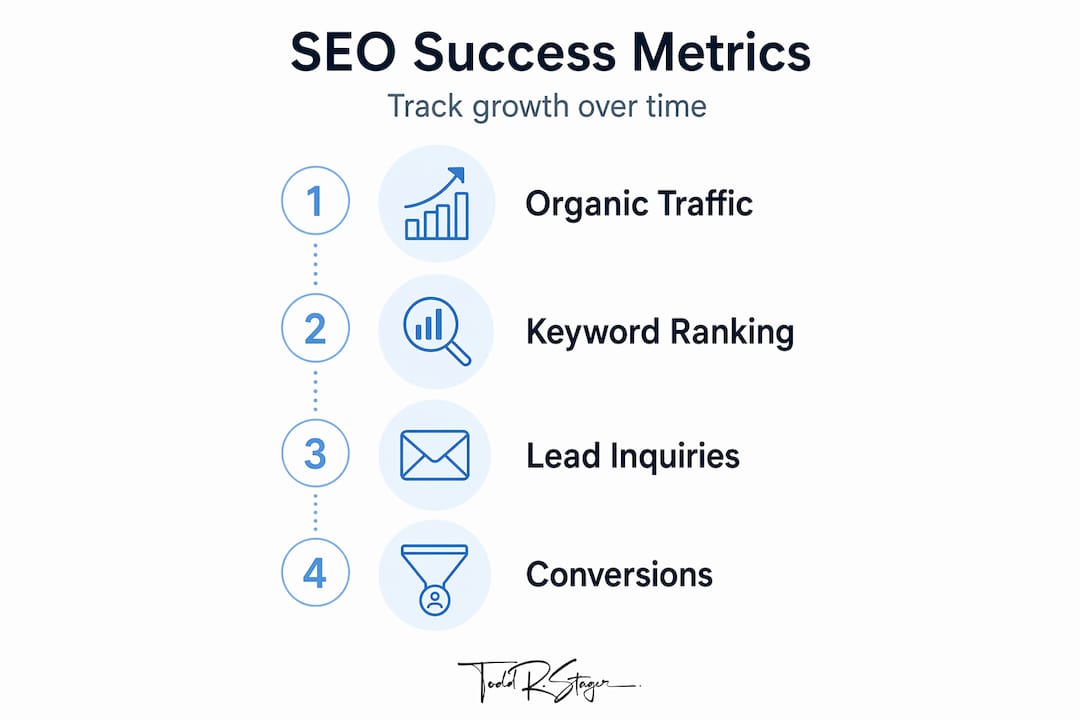
Measuring SEO success over time
SEO without measurement is guesswork. The good news is that Google Analytics and Search Console give you a clear picture of what is working, what is not, and where the best opportunities lie. They are free and give you more useful data than most paid tools.
Here are the metrics that actually matter for CPA firms:
- Organic traffic by page: See which service pages and blog posts attract the most visitors from search. If your tax preparation page gets ten visits a month and your bookkeeping page gets three hundred, that tells you something important about where to invest more content.
- Keyword rankings: Track where specific phrases rank over time. Movement matters more than position. A phrase climbing from position 22 to position 8 is a signal that your content is gaining authority.
- Conversion rate from organic traffic: This is the number that connects SEO to revenue. Are visitors submitting contact forms, calling your office, or downloading a resource? If your organic traffic is high but conversions are low, the problem is likely on-page trust signals, not rankings.
- Bounce rate and dwell time: If visitors land on a page and leave in under ten seconds, the page is not answering what they came to find. That mismatch hurts both conversions and rankings over time.
| Metric | What it tells you | Tool |
|---|---|---|
| Organic sessions | Volume of search-driven visitors | Google Analytics 4 |
| Average position | Where pages rank for key queries | Google Search Console |
| Click-through rate | How compelling your listing looks in results | Google Search Console |
| Goal completions | How many visitors take a desired action | Google Analytics 4 |
| Core Web Vitals | Technical performance score | Google Search Console |
Review these numbers monthly, not annually. SEO shifts gradually, and catching a traffic drop early lets you course-correct before it affects your pipeline.
Common SEO mistakes CPAs make
The most expensive SEO mistake is not doing anything wrong technically. It is being generic. A website that says “we serve businesses and individuals with all their accounting needs” gives search engines no clear signal and gives prospects no reason to choose you over anyone else.
Here are the pitfalls that consistently hold CPA firms back:
- Ignoring local SEO entirely. Most clients want a local accountant they can meet in person or at least reach easily. Skipping geographic keywords and Google Business Profile optimization means missing the searches most likely to convert.
- Treating the website as a digital business card. A static site with a services list and a phone number does not rank. Active sites with regularly updated content, clear service pages, and fresh reviews send the signals Google rewards.
- Obsessing over rankings while ignoring conversions. Ranking number one for a keyword that does not match your ideal client profile is a vanity metric. The goal is qualified leads, not position bragging rights.
- Publishing content without a structure. Random blog posts on disconnected topics do not build topical authority. Content needs to connect to service pages and form clusters that reinforce your expertise in specific areas. Google’s EEAT framework rewards content authored by credible experts, and that requires consistency and depth, not volume.
- Neglecting mobile users. More than half of local searches happen on smartphones. A site that loads slowly or displays poorly on mobile loses those visitors immediately, and those losses compound over time in search rankings.
For a broader view of how these principles apply beyond CPA firms, the 2026 SEO ranking factors guide covers what Google currently prioritizes for service businesses.
My take on SEO and CPA firm growth
I’ve worked with professional services firms long enough to know that the biggest barrier to SEO success is not technical. It’s a mindset problem. Most CPAs think of their website as a credential display, not a client acquisition tool.
What I’ve learned is that the firms growing fastest online are not the ones with the biggest budgets. They are the ones that commit to saying something specific. They pick a niche, they own it online, and they build content that proves their expertise in that niche rather than trying to appeal to everyone.
The shift to AI-driven search has made this even more urgent. I’ve seen firms with perfectly fine websites lose ground simply because their messaging was too broad. When an AI tool is deciding which CPA to recommend, it is looking for clarity and proof. Vague wins nothing.
My honest advice: stop thinking about SEO as a marketing expense and start treating it as your digital reputation infrastructure. The CPAs who will grow in the next five years are the ones who show up online the way they show up in the room: confident, specific, and clearly the right person for the job.
The benefits of SEO for CPAs go well beyond traffic numbers. They compound over time into a practice that attracts the right clients rather than chasing any client.
— TODD
Let Toddstager help your firm get found
At Toddstager, we specialize in SEO for professional service firms, including CPAs and financial professionals who need more than generic marketing advice. We build strategies around your specific services, your local market, and the client types you actually want to serve. That means optimizing service pages that rank, creating content that builds credibility, and managing the technical details that keep your site performing well over time.
If you are ready to move from invisible to indispensable online, explore our SEO for financial services page to see how we approach lead generation for firms like yours. You can also dig into our SEO lead generation guide for small service businesses to understand the full strategy. Contact Toddstager to discuss a tailored plan built around your firm’s growth goals.
FAQ
What is the role of SEO for CPAs?
SEO helps CPA firms appear in search results when potential clients are actively looking for accounting and tax services. It captures high-intent searches at the moment someone is ready to hire, making it one of the most direct forms of client acquisition available.
How does local SEO benefit accounting firms?
Local SEO puts your firm in front of prospects searching for CPAs in a specific city or neighborhood. Optimizing your Google Business Profile and using location-specific keywords increases your visibility in map results, which appear at the top of most local accounting searches.
Does AI search change how CPAs should approach SEO?
Not fundamentally. Google’s AI search features build on the same quality signals as traditional SEO. The key difference is that AI tools now select a single recommended firm, so clarity, consistency, and specificity in your online messaging matter more than ever.
Which SEO metrics should a CPA firm track?
Focus on organic traffic by page, keyword ranking trends, conversion rate from organic visitors, and Core Web Vitals. These four data points give you a direct line of sight from SEO investment to actual client inquiries.
How often should CPA firms update their website content?
At minimum, review and update service pages twice a year and publish fresh content monthly. Google’s EEAT framework rewards consistently updated, expert-authored content, and regular activity signals to search engines that your site is current and authoritative.