


TL;DR:
- A phased SEO workflow helps real estate agents increase local visibility, attract qualified leads, and build credibility.
- Focusing on technical setup, hyper-local keywords, original content, and authority building ensures sustainable growth and better search rankings.
You have deep local knowledge, a polished website, and years of experience, yet Zillow and Realtor.com keep capturing the clients who should be calling you. This is the frustrating reality for most agents: national portals dominate broad search terms while your expertise goes unseen. A phased SEO workflow changes that equation. By moving through technical setup, local keyword research, content creation, and authority building in a deliberate sequence, you create compounding visibility that attracts qualified leads and builds lasting credibility in your market.
Key Takeaways
| Point | Details |
|---|---|
| Phased SEO workflow | Breaking SEO into technical, keyword, content, authority, and tracking phases maximizes agent visibility. |
| Hyper-local keyword targeting | Focusing on specific neighborhoods and intent modifiers outperforms broad, competitive terms. |
| Standout local content | Original guides and tailored FAQs attract buyers and sellers, supporting expertise and rankings. |
| Authority signals matter | Reviews, local citations, and authoritative bios/testimonials are essential for sustained success. |
| Track and refine | Monitoring benchmarks and optimizing quarterly ensures continuous traffic and lead growth. |
Overview of the SEO workflow for real estate agents
Having set the stage for why SEO matters, let’s break down the workflow that delivers results.
A phased approach keeps progress measurable and prevents the overwhelm that comes from trying to fix everything at once. The core workflow follows four focused weeks: Week 1 covers technical setup and Google Business Profile (GBP) optimization; Week 2 targets hyper-local keyword research; Week 3 focuses on content creation with AI assistance and human editing; Week 4 builds authority through reviews and backlinks. This structure ensures each layer supports the next.
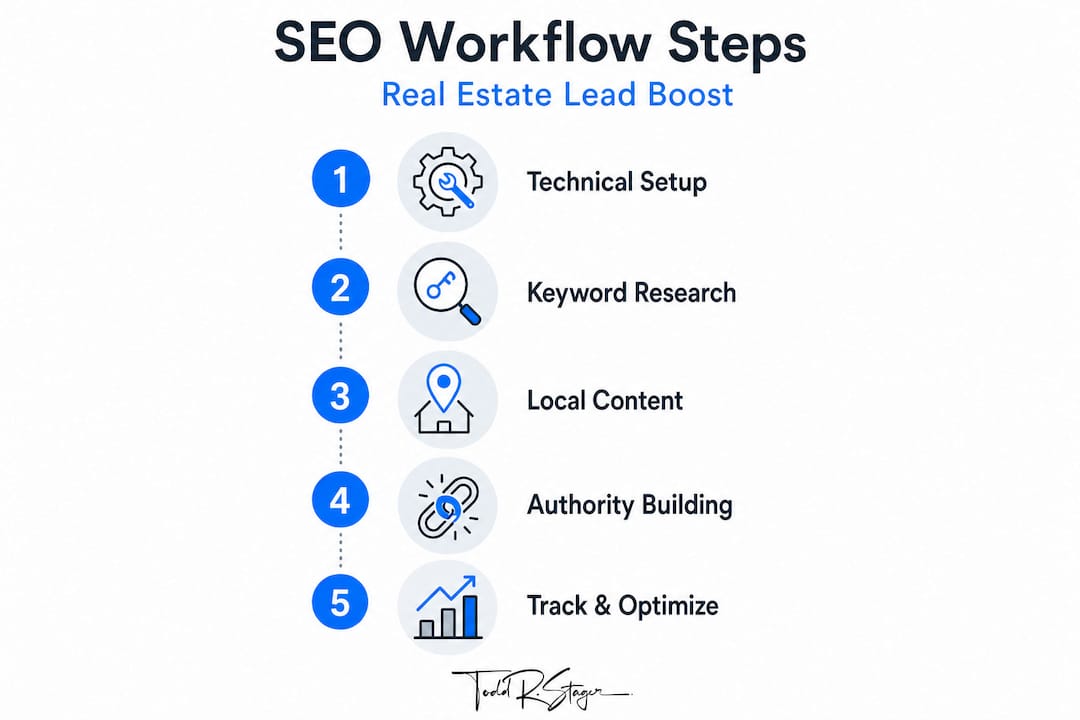
Here is how a phased agent workflow compares to a generic approach:
| Factor | Phased agent workflow | Generic SEO approach |
|---|---|---|
| Keyword focus | Hyper-local, intent-driven | Broad, competitive |
| Content type | Neighborhood guides, market reports | Generic blog posts |
| Local signals | GBP, citations, reviews | Minimal local effort |
| Timeline | Steady, measurable progress | Unpredictable results |
| ROI clarity | Tracked from day one | Often unclear |
The phases you will follow include:
- Technical SEO and GBP optimization
- Hyper-local keyword research and silo building
- Original content creation targeting buyer and seller intent
- Authority building through reviews, citations, and backlinks
- Ongoing tracking and optimization
Exploring real estate SEO strategies in depth alongside these essential SEO strategies gives you a fuller picture of how each phase connects.
Step 1: Technical SEO setup and Google Business Profile optimization
After outlining the workflow, the foundational step is technical optimization. Let’s see what it involves.
Your site’s technical health directly affects whether Google can crawl, index, and rank your pages. The technical essentials include mobile-first page speed under three seconds, HTTPS security, schema markup (LocalBusiness, RealEstateAgent, and AggregateRating types), fixing IDX (Internet Data Exchange) duplicate content via no-index tags or canonical URLs, an XML sitemap, and internal linking silos that group related pages together.
Here are the core technical tasks to complete in Week 1:
- Run a speed test using Google PageSpeed Insights and fix issues slowing mobile load time.
- Confirm your site uses HTTPS and resolve any mixed-content warnings.
- Add LocalBusiness and RealEstateAgent schema markup to your homepage and key pages.
- Apply no-index tags or canonical URLs to generic IDX listing pages to prevent duplicate content penalties.
- Submit an XML sitemap to Google Search Console.
- Build internal linking silos connecting your city pages, neighborhood guides, and service pages.
On the GBP side, Map Pack visibility captures more clicks than standard organic results. Select “Real Estate Agent” as your primary category, add all services you offer, upload high-quality photos of your team and listings, post weekly updates, and respond to every review promptly.
| GBP element | Why it matters |
|---|---|
| Primary category | Determines which searches trigger your listing |
| Service list | Matches specific buyer/seller queries |
| Weekly posts | Signals active, relevant business to Google |
| Photo uploads | Increases engagement and click-through rate |
| Review responses | Builds trust and improves local ranking signals |
Pro Tip: Respond to every GBP review within 48 hours, even negative ones. Consistent responses signal to Google that your business is active and trustworthy, which directly supports Map Pack rankings. Applying technical SEO best practices from adjacent industries can also reveal quick wins for your own setup.
Step 2: Hyper-local keyword research for maximum reach
With technical foundations in place, your next focus is targeting the right search terms, those your local buyers and sellers actually use.
Broad terms like “homes for sale” or “real estate agent” are dominated by Zillow, Trulia, and Realtor.com. You cannot outrank them on those terms, and you should not try. Instead, target hyper-local, long-tail keywords like “Wicker Park condos for sale,” “Austin homes near Dell Children’s Medical Center,” or “luxury homes in Scottsdale 85254.” These phrases have lower competition and higher purchase intent.
Build your keyword strategy using geo clusters:
- Start at the city level: “Chicago real estate agent,” “homes for sale in Chicago.”
- Move to neighborhoods: “Lincoln Park condos,” “River North luxury apartments.”
- Drill into ZIP codes: “85254 homes for sale,” “60614 townhomes.”
- Layer in intent modifiers: buy, sell, rent, invest, luxury, first-time buyer.
- Map each keyword cluster to a dedicated page or content piece to avoid keyword cannibalization (two pages competing for the same term).
Statistic callout: Organic traffic from hyper-local SEO can account for 42 to 48% of total site traffic, making it the single largest traffic source when executed correctly.
Keyword cannibalization is a common mistake. It happens when multiple pages target the same term, splitting your ranking potential. Assign one primary keyword per page and use supporting terms as secondary targets. Review your real estate SEO success roadmap to see how keyword silos translate into consistent lead flow.
Pro Tip: Revisit your keyword list every quarter. Search behavior shifts with seasons, market conditions, and neighborhood development. Fresh keyword data keeps your content aligned with what buyers and sellers are actually searching for right now.
Step 3: Create standout hyper-local content for buyers and sellers
Armed with hyper-local keyword insights, you are ready to create content that converts. Here is how to stand out.
Generic MLS listing descriptions do nothing for SEO. What performs is original, locally specific content that answers real questions buyers and sellers are asking. Neighborhood guides of 1,500 to 2,500 words, monthly market reports, buyer and seller FAQs, and school district breakdowns all build the kind of authority Google rewards. Add original photos, clear calls to action, and unique introductions to any IDX listing pages you keep indexed.
Content types that consistently perform well:
- Neighborhood guides: Cover lifestyle, schools, commute times, local businesses, and price trends.
- Market reports: Monthly or quarterly data with your own analysis, not just numbers.
- Buyer and seller FAQs: Answer the specific questions your clients ask during consultations.
- Comparison pages: “Living in [Neighborhood A] vs. [Neighborhood B]” pages attract decision-stage searchers.
- Video walkthroughs embedded on pages: Increase dwell time (the amount of time a visitor spends on your page), which signals quality to Google.
“AI content must be human-edited for local voice to avoid filters. A neighborhood guide written entirely by AI and published without editing sounds generic, lacks real insight, and fails to reflect the authentic local knowledge that Google’s E-E-A-T (Experience, Expertise, Authoritativeness, Trustworthiness) standards reward.”
Supplementing your IDX listings with unique value is critical. Add a custom intro paragraph to each listing area page, include a local market snapshot, and link to your neighborhood guide. This turns thin, duplicate-prone content into a genuinely useful resource. A well-structured professional SEO workflow helps you produce this content consistently without burning out.
Step 4: Build trust and authority for sustained rankings
Creating great content is not enough in isolation. Now, learn to build the authority that powers rankings.
Authority in SEO comes from three sources: citations (consistent name, address, and phone number listings across directories), backlinks (links from other reputable websites to yours), and on-site trust signals like bios, testimonials, and credentials. Building 50 or more consistent NAP citations across directories like Yelp, Realtor.com, Homes.com, and local chamber sites, combined with a minimum of 10 Google reviews and active responses to all of them, creates the authority foundation that sustains rankings over time.
| Authority source | Examples | SEO impact |
|---|---|---|
| Directory citations | Yelp, Realtor.com, Homes.com | Local ranking signals |
| Local backlinks | Chamber of commerce, schools, news sites | Domain authority growth |
| Google reviews | 10+ with responses | Map Pack ranking factor |
| E-E-A-T signals | Agent bio, credentials, testimonials | Trust and ranking quality |
Outreach targets for local backlinks:
- Local chamber of commerce membership pages
- Community event sponsorships with website mentions
- School district and neighborhood association websites
- Local news outlets covering real estate market trends
- Mortgage lenders and title companies for mutual linking
Pro Tip: Aim for at least 10 Google reviews before pursuing backlinks. Reviews are a direct Map Pack ranking factor and build the social proof that makes your backlink outreach more credible. Agents working in property management SEO often use the same citation and review strategies with strong results.
Step 5: Track results and optimize for ongoing growth
You have built authority. Now see how to measure your wins and keep momentum strong.

Tracking is what separates agents who grow consistently from those who plateau. Connect your site to Google Analytics 4 and Google Search Console from day one. Monitor organic traffic trends, keyword ranking movement, GBP profile views, and most importantly, visitor-to-lead conversion rate (the percentage of site visitors who contact you or fill out a form).
| Metric | Benchmark | Tool |
|---|---|---|
| Organic traffic growth | 10 to 50% per quarter | Google Analytics 4 |
| Visitor-to-lead rate | 2.2 to 5% | Google Analytics 4 |
| Organic cost per lead | $15 to $60 | CRM tracking |
| Keyword rankings | Page 1 for target terms | Google Search Console |
| GBP profile views | Month-over-month growth | GBP Insights |
Statistic callout: SEO benchmarks for real estate show an organic cost per lead of $15 to $60 compared to $100 or more from paid portals, with an ROI of up to 1,389% and a typical breakeven point around 13 months.
Case studies reinforce the potential. Optimized real estate sites have achieved first-page rankings in 60 to 72 days, with traffic increases of 172 to 500% and leads tripling through well-structured pages. These are not outliers. They reflect what happens when the workflow is followed consistently.
Optimization steps to run monthly:
- Refresh any page that dropped in rankings with updated data and expanded content.
- Add internal links from new content to older, high-value pages.
- Check GBP for unanswered reviews or outdated information.
- Review your lead generation guide to identify conversion gaps on your top landing pages.
- Identify new hyper-local keyword opportunities based on recent client questions.
The unconventional truth about real estate SEO
Beyond workflows and checklists, there is a deeper truth most agents overlook.
I have seen agents invest months into content, only to chase keywords that Zillow owns outright. The uncomfortable reality is that competing broadly is a losing strategy by design. Portals have domain authority scores that individual agents simply cannot match in the short term. The agents who win are the ones who stop trying to be everything to everyone and instead become the undisputed local expert for a specific neighborhood, price range, or buyer type.
Quality beats volume every time. One deeply researched, 2,000-word neighborhood guide with original photos, local market data, and a clear call to action will outperform ten generic 500-word posts. Google’s E-E-A-T framework rewards demonstrated experience and real expertise, not content quantity. As I’ve learned from working with agents across different markets, the ones who publish less but publish better consistently outrank the ones chasing content volume.
“Content volume without quality fails. Prioritize depth and E-E-A-T over quantity.”
Patience is also non-negotiable. SEO takes 6 to 12 months to show its full potential. Fast wins are possible, as the case studies show, but they are not guaranteed. Agents who treat SEO as a long-term asset rather than a quick-fix channel are the ones who build sustainable lead pipelines. Explore advanced SEO strategies to go deeper on the tactics that separate good rankings from dominant ones.
Next steps: Boost your results with expert real estate SEO
With a proven workflow and a clearer understanding of what drives local rankings, the next step is putting it into practice with the right support behind you.
Getting the technical setup right, building a keyword silo that actually fits your market, and producing content that converts takes time and expertise. That is where specialized guidance makes the difference. Whether you are starting from scratch or optimizing an existing site, working with experts who focus exclusively on real estate SEO shortens the learning curve significantly. Explore dedicated SEO help for real estate agents, review the full scope of SEO strategies for real estate, and dive into advanced agent SEO strategies to find the right level of support for where you are right now.
Frequently asked questions
How long does it take to see results from real estate SEO?
Agents typically see meaningful results after 6 to 12 months, though fast wins are possible with first-page rankings appearing in 60 to 72 days for new sites following the right workflow.
What are the most important technical SEO fixes for real estate agents?
The most critical fixes are mobile speed under three seconds, HTTPS, schema markup, and blocking duplicate IDX content with no-index tags or canonical URLs.
How do I optimize for Google’s Map Pack as a real estate agent?
Select “Real Estate Agent” in your GBP category, list all services, upload photos, post weekly updates, and respond to every review to maximize Map Pack visibility.
What content performs best for local real estate SEO?
Neighborhood guides of 1,500 to 2,500 words, monthly market reports, original buyer and seller FAQs, and listing pages with unique intros and local photos consistently outperform generic content.
How much does organic lead generation cost compared to paid portals?
Organic leads cost $15 to $60 per lead versus $100 or more from paid portals, with up to 1,389% ROI and 10 to 50% traffic growth per quarter.