


Lead generation is the process of attracting potential customers who show interest in your products or services. For small businesses across the USA, search engine optimization offers a powerful alternative to paid advertising by building sustainable visibility in search results. While many business owners focus on immediate returns from pay-per-click campaigns, SEO creates compounding benefits that generate qualified leads month after month. This guide reveals how SEO transforms lead generation for service-based businesses, why it outperforms paid ads over time, and practical strategies you can implement in 2026 to capture more customers organically.
Key takeaways
| Point | Details |
|---|---|
| SEO delivers superior long-term ROI | After nine months of consistent effort, SEO generates 7.3x return compared to PPC’s 3.8x return for most small businesses. |
| Hybrid approach maximizes results | Combining SEO with targeted PPC campaigns produces the highest quality lead flow while building sustainable organic visibility. |
| Local optimization drives nearby leads | Optimizing for local search terms and Google Business Profile captures customers actively searching for services in your area. |
| Content quality determines conversion | High-value content addressing customer pain points converts visitors into leads more effectively than generic promotional pages. |
Understanding SEO and its impact on lead generation
Search engine optimization is the practice of improving your website’s visibility in organic search results through strategic content, technical improvements, and authority building. Lead generation through SEO happens when potential customers find your business while searching for solutions to their problems. Unlike paid advertising that stops delivering the moment you pause spending, SEO creates lasting visibility that continues attracting qualified prospects.
Organic traffic from search engines brings visitors who actively seek what you offer, making them more likely to convert than cold audiences reached through display ads. When someone searches “emergency plumber near me” or “chiropractor accepting new patients,” they demonstrate clear intent and immediate need. Ranking for these searches puts your business directly in front of ready-to-buy customers.

The compounding nature of SEO makes it particularly valuable for small businesses with limited marketing budgets. Each piece of optimized content, every earned backlink, and all technical improvements build upon previous efforts. Research shows SEO delivers 7.3x ROI compared to PPC’s 3.8x, with 63% of marketers reporting higher returns after nine months of consistent optimization. This multiplier effect means your investment today continues paying dividends for years.
Small businesses benefit most when they target specific, relevant keywords that match their services and local market. A roofing company in Phoenix gains more value ranking for “tile roof repair Phoenix” than competing for the generic term “roofing.” This precision targeting through SEO for service industries ensures you attract prospects who need exactly what you provide.
Content quality determines whether visitors become leads. Search engines prioritize pages that thoroughly answer user questions and provide genuine value. Creating comprehensive guides, how-to articles, and service pages that address customer concerns establishes your expertise while improving rankings. This approach transforms your website into a lead generation asset that works continuously.
Pro Tip: Focus on long-tail keywords with three or more words that indicate specific intent. These phrases face less competition and attract visitors closer to making purchase decisions, resulting in higher conversion rates for small business websites.
Key factors that amplify SEO’s lead generation impact:
- Website authority built through quality backlinks from industry publications and local business directories
- Technical optimization ensuring fast load times and mobile responsiveness for better user experience
- Strategic internal linking that guides visitors toward conversion pages and contact forms
- Regular content updates demonstrating active expertise and keeping your site fresh in search algorithms
SEO vs pay-per-click (PPC): balancing immediate gains and long-term growth
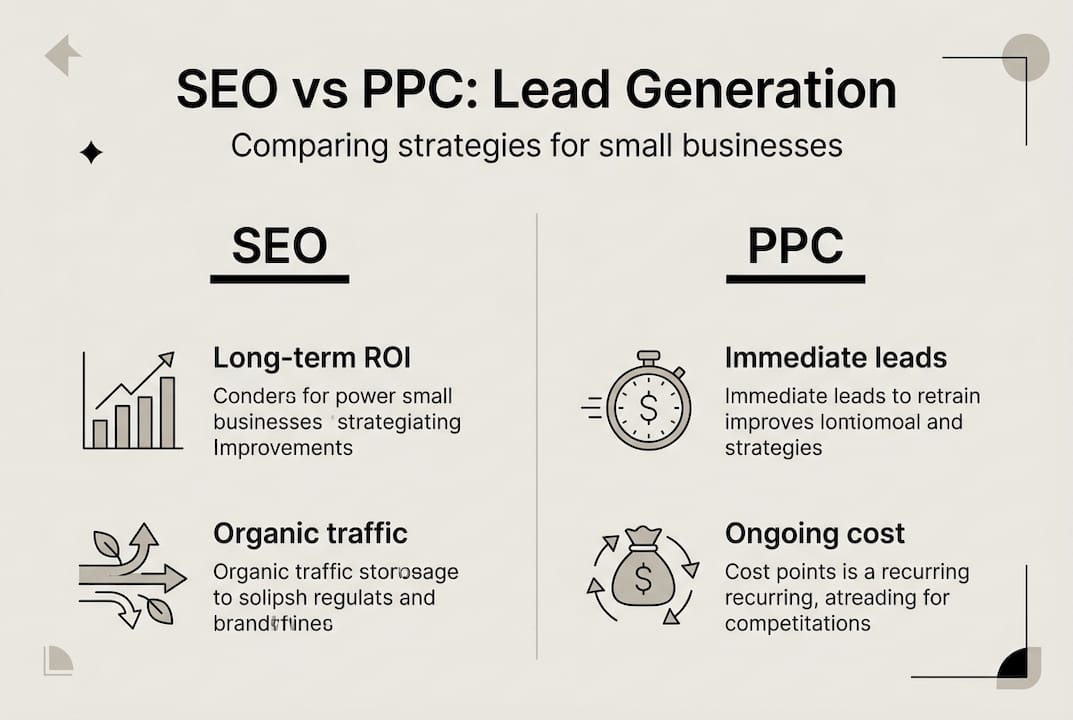
Pay-per-click advertising delivers immediate visibility but requires continuous spending to maintain traffic flow. You bid on keywords, create ads, and pay each time someone clicks through to your site. The moment you stop funding campaigns, traffic disappears entirely. This makes PPC excellent for testing new services, promoting limited-time offers, or generating quick leads during slow periods.
SEO requires patience and consistent effort before showing results, typically taking three to nine months to gain meaningful traction. However, once your pages rank well, they continue attracting visitors without per-click costs. A meta-analysis showed an effect size of 1.049 for combined SEO and PPC approaches, indicating the strategies work best together rather than as competitors.
The cost structure differs dramatically between these approaches. PPC demands ongoing budget allocation with costs rising as competition increases for valuable keywords. Popular terms in competitive industries like legal services or home improvement can cost $50 to $200 per click. SEO involves upfront investment in content creation, technical improvements, and link building, but delivers compounding returns as rankings improve.
| Factor | SEO | PPC |
|---|---|---|
| Time to results | 3-9 months for meaningful traffic | Immediate upon campaign launch |
| Cost structure | Upfront investment, decreasing cost per lead over time | Continuous spending, fixed cost per click |
| Sustainability | Compounds over time, maintains visibility without ongoing spend | Stops immediately when budget runs out |
| Lead quality | Higher intent, typically better conversion rates | Variable, depends on targeting precision |
| ROI timeline | Superior returns after 9+ months | Better short-term returns, lower long-term ROI |
Smart small businesses use PPC to generate immediate leads while building SEO foundations for sustainable growth. Start with targeted paid campaigns for your most profitable services, then reinvest a portion of revenue into content creation and optimization. As organic rankings improve, gradually reduce PPC spending while maintaining visibility.
Lead quality often differs between channels. Organic visitors tend to trust search results more than ads, viewing top-ranked businesses as more established and credible. This perception translates into higher conversion rates and better customer lifetime value. Paid traffic can still convert well when campaigns target specific, high-intent keywords and lead to optimized landing pages.
Pro Tip: Allocate 70% of your marketing budget to SEO during growth phases, keeping 30% for PPC campaigns targeting high-value keywords where you haven’t achieved top organic rankings yet. This balance maintains lead flow while building long-term assets.
Industry-specific considerations matter when choosing between SEO and PPC. Service businesses with emergency needs like plumbing or HVAC repair benefit from PPC’s immediacy during peak seasons. Professional services like SEO for roofing companies or medical practices gain more from SEO’s authority-building effects. Evaluate your customer journey and sales cycle when allocating resources between channels.
The competitive landscape in your market also influences strategy. In saturated markets with high PPC costs, SEO becomes more attractive despite longer timelines. Emerging businesses in less competitive niches might find quick PPC wins while simultaneously building organic presence. SEO services for small businesses can help determine the optimal mix for your specific situation.
Practical SEO strategies to generate and convert leads in 2026
Local SEO captures customers searching for services in your geographic area, making it essential for small businesses serving specific regions. Optimize your Google Business Profile with accurate information, high-quality photos, and regular posts about services and promotions. Encourage satisfied customers to leave reviews, as positive ratings significantly influence both rankings and conversion rates.
Website speed and mobile usability directly impact both search rankings and lead conversion. Google prioritizes fast-loading, mobile-responsive sites in search results. Test your site speed using free tools and address issues like oversized images, unnecessary plugins, or slow hosting. More than 60% of searches now happen on mobile devices, making responsive design non-negotiable for lead generation.
Content creation focused on customer pain points attracts qualified traffic and establishes expertise. Identify questions your prospects ask during sales conversations, then create comprehensive guides addressing these concerns. A chiropractor might write about “relieving lower back pain without surgery” while a CPA could explain “maximizing deductions for self-employed professionals.” This approach positions you as a trusted advisor before prospects ever contact you.
Conversion rate optimization transforms traffic into leads by removing friction from your contact process. Place clear calls-to-action above the fold on service pages. Offer multiple contact options including phone, email, and web forms to accommodate different preferences. Use compelling headlines that emphasize benefits rather than features, making it immediately clear how you solve customer problems.
Implement these sequential steps to build effective lead generation through SEO:
- Conduct keyword research identifying terms your ideal customers use when searching for your services
- Audit your current website identifying technical issues, slow pages, and content gaps
- Create cornerstone content pieces thoroughly addressing your most valuable service offerings
- Optimize existing pages with target keywords in titles, headings, and naturally throughout content
- Build local citations by listing your business in relevant directories with consistent NAP information
- Develop a content calendar publishing helpful articles and guides monthly to demonstrate ongoing expertise
- Earn quality backlinks by creating resources other sites want to reference and building relationships with industry publications
- Monitor performance using analytics to identify which pages generate leads and double down on successful approaches
Google Business Profile optimization deserves special attention for local lead generation. Complete every section of your profile including services, hours, and attributes. Post weekly updates about projects, tips, or seasonal offerings to maintain active engagement. Respond promptly to all reviews, both positive and negative, showing prospects you value customer feedback.
Review management builds trust and influences local rankings. After 63% of marketers report higher ROI from SEO after nine months, maintaining positive reviews becomes crucial for sustaining that success. Implement systematic review requests after successful project completion. Address negative feedback professionally and publicly to demonstrate commitment to customer satisfaction.
Common pitfalls that undermine lead generation efforts:
- Targeting overly broad keywords that attract unqualified traffic with no local intent
- Neglecting mobile optimization despite majority of searches happening on smartphones
- Creating thin content that fails to thoroughly address customer questions and concerns
- Ignoring local citations and NAP consistency across online directories
- Overlooking conversion optimization by focusing solely on traffic without clear calls-to-action
- Expecting immediate results and abandoning SEO before it gains traction
Specialized industries require tailored approaches. Medical professionals benefit from SEO for chiropractors strategies emphasizing trust signals and patient education. Healthcare providers should review SEO examples for doctors to understand compliance considerations and effective patient acquisition tactics. Service businesses across sectors can adapt proven SEO strategies to their specific market conditions.
Schema markup helps search engines understand your content and can generate rich snippets in results. Implement local business schema with your address, phone number, and service areas. Add FAQ schema to question-and-answer content for better visibility. Review schema encourages star ratings to appear in search results, increasing click-through rates from qualified prospects.
Boost your lead generation with expert SEO services
Implementing comprehensive SEO strategies requires specialized knowledge and consistent effort that many small business owners struggle to maintain while running daily operations. Professional SEO services accelerate results by applying proven tactics tailored to your industry and local market. Todd Stager delivers customized solutions for service-based businesses across multiple sectors, from healthcare to home services.
Specialized packages exist for specific industries including SEO for chiropractors and SEO examples for doctors, addressing unique compliance requirements and patient acquisition challenges. Whether you operate a medical practice, home service business, or professional services firm, expert guidance ensures you avoid costly mistakes while building sustainable lead generation systems. Explore SEO services for small businesses to discover how professional optimization can transform your customer acquisition and accelerate growth in 2026.
FAQ
How quickly can small businesses see lead results from SEO?
SEO typically begins showing measurable lead generation after three to nine months of consistent optimization efforts. Initial improvements in rankings for less competitive keywords may appear within weeks, but meaningful traffic growth takes longer. The timeline depends on your industry’s competitiveness, current website authority, and the quality of your optimization efforts. Businesses in less competitive niches or local markets often see results faster than those in saturated industries.
Is SEO more cost-effective than paid ads for lead generation?
Research demonstrates SEO delivers 7.3x ROI compared to PPC’s 3.8x after sustained investment, making it significantly more cost-effective long term. Paid advertising provides faster initial results but requires continuous spending to maintain traffic flow. SEO demands upfront investment in content and optimization but creates compounding returns as rankings improve. Most small businesses achieve better overall results by combining both strategies, using PPC for immediate needs while building SEO for sustainable growth.
What are the first steps for small businesses to start effective SEO lead generation?
Begin by optimizing your website with targeted local keywords that match how customers search for your services in your area. Ensure your site loads quickly and displays properly on mobile devices, as these factors significantly impact both rankings and conversion rates. Create comprehensive content addressing common customer questions and pain points to establish expertise and attract qualified traffic. Consider consulting SEO services for small businesses to develop a tailored strategy that accelerates results while avoiding common mistakes that waste time and resources.
Should small businesses focus on local or national SEO for lead generation?
Most service-based small businesses generate better ROI from local SEO targeting customers within their geographic service area. Local optimization captures high-intent searches from nearby prospects ready to hire, resulting in higher conversion rates and better quality leads. National SEO makes sense only if you offer services across multiple states or sell products shippable nationwide. Evaluate where your actual customers come from and focus optimization efforts on those geographic areas to maximize lead generation efficiency.
How does content quality affect SEO lead generation success?
Search engines prioritize content that thoroughly answers user questions and provides genuine value, making quality the primary ranking factor in 2026. Comprehensive guides addressing customer pain points attract more qualified traffic and convert visitors into leads more effectively than thin, promotional content. High-quality content also earns natural backlinks from other sites, improving your overall domain authority and rankings. Invest in creating detailed, helpful resources rather than publishing numerous shallow pages to achieve sustainable lead generation growth.