


Over 70% of local mobile searches lead to a store visit within 24 hours, making local SEO critical for moving companies competing for customers in their service areas. In 2026, winning local search rankings requires more than keywords. You need optimized local signals, technical health, and reputation management. This guide walks you through actionable local SEO strategies tailored specifically for moving companies to attract qualified leads and grow your business.
Key takeaways
| Point | Details |
|---|---|
| Local SEO drives immediate, qualified leads | Moving customers search locally with high intent, making local visibility essential for conversions. |
| Google Business Profile optimization is critical | Appearing in local pack and map results requires an active, fully optimized profile. |
| Reviews and local links build trust and rankings | Managing reputation and earning authoritative backlinks improve both credibility and search performance. |
| Technical SEO enhances user experience | Site speed, mobile optimization, and structured data directly impact local pack presence and lead generation. |
| Combining organic and paid search maximizes ROI | Integrated strategies deliver 35% higher returns than relying on one channel alone. |
Why local SEO matters for moving companies
Moving services are intensely local. Customers rarely search beyond their immediate area, making local visibility the difference between a full schedule and empty trucks. Local search drives qualified leads specifically for moving services because searchers have immediate intent to book.
Your Google Business Profile is your digital storefront. It determines whether you appear in the local pack and map results where most customers click first. Without optimization, you’re invisible to nearby searchers ready to hire.
Local SEO delivers cost-effective leads compared to broad advertising. You’re not paying for clicks from people 500 miles away. You’re capturing customers in your service radius actively looking for movers.
Mobile searches dominate local queries. People search for moving companies on their phones while planning relocations, comparing quotes, and reading reviews. If your site isn’t mobile-optimized and locally visible, you lose these high-intent customers.
Local signals differentiate you in crowded markets. Competitors may offer similar services, but strategic marketing approaches combined with strong local SEO make you the obvious choice. Key local ranking factors include:
- Google Business Profile completeness and activity
- Consistent NAP (name, address, phone) across directories
- Quality and quantity of customer reviews
- Local backlinks from community organizations
- Localized on-page content and keywords
Pro Tip: Claim and verify your Google Business Profile immediately if you haven’t already. It’s free and the single most impactful local SEO action you can take today.
Keyword research and targeting for moving companies
Effective keyword research starts with understanding how moving customers search. They use specific location modifiers like “movers near me,” “moving companies in [city],” and “[neighborhood] relocation services.” These geo-targeted terms capture high-intent traffic.
Use Google Keyword Planner to identify local moving terms with commercial intent. Look for keywords combining your service with location qualifiers. Examples include “long distance movers Seattle” or “apartment moving Brooklyn.”
Analyze competitors’ top local keywords to find gaps. Check which terms they rank for using SEO tools, then target opportunities they’ve missed. If competitors dominate “residential movers,” you might focus on “senior moving services” or “office relocation.”
Prioritize commercial and informational keywords relevant to moving services. Commercial terms like “hire movers [city]” signal ready buyers. Informational keywords like “moving cost calculator” or “packing tips” attract earlier-stage prospects you can nurture.
Regularly update your keyword list to reflect seasonal changes. Summer is peak moving season, so keywords like “summer movers” or “school break relocation” gain volume. Winter might shift to “winter moving discounts” or “holiday relocation services.”
Target a mix of head terms and long-tail variations:
- Head terms: “movers [city],” “moving company [state]”
- Long-tail: “affordable piano movers [neighborhood],” “same day moving service [city]”
- Question-based: “how much do movers cost in [city],” “best time to hire movers”
Pro Tip: Create a spreadsheet of your top 20 local keywords with search volume and competition data. Review quarterly and adjust based on what’s driving actual leads.
On-site content strategies built around moving customers’ needs
Creating customer-focused content addressing common moving pain points attracts organic traffic and builds trust. Moving company SEO content that educates while showcasing expertise converts browsers into customers.
Packing and moving tips content can increase traffic by 45% by capturing informational searches. Blog posts like “10 Packing Mistakes That Cost You Money” or “How to Pack Fragile Items Safely” establish authority while targeting keywords customers actually search.
Use FAQs and dedicated service pages to capture search intent. Answer questions like “What’s included in full-service moving?” or “Do I need insurance for my move?” These pages rank for specific queries and move prospects closer to booking.
Incorporate multimedia like videos and customer testimonials to boost engagement. A 2-minute video showing your team carefully handling belongings builds confidence. Written testimonials with photos add social proof that improves conversion rates.
Steps to plan and create valuable moving content:
- Survey past customers to identify their biggest pre-move questions and concerns
- Research keyword opportunities using Google Search Console and keyword tools
- Create a content calendar mapping topics to seasonal demand and customer journey stages
- Write in-depth guides (1,500+ words) for high-value topics like cost estimation or moving checklists
- Optimize each piece with local keywords, internal links, and clear calls to action
- Promote content through email newsletters and social media to existing customers
Types of content moving customers search for:
- Comprehensive moving checklists (30 days out, 2 weeks out, moving day)
- Detailed cost guides breaking down pricing factors and hidden fees
- Service area pages optimized for each city or neighborhood you serve
- Comparison guides (DIY vs professional movers, local vs long distance)
- Seasonal tips (winter moving precautions, summer heat considerations)
Address price objections directly in your content by explaining value. Don’t just list services; show how professional packing prevents damage or how efficient crews save customers time and stress.
Managing reviews and online reputation for moving companies
Negative reviews can reduce conversions by 30%, making reputation management essential for moving companies. Potential customers read reviews before booking, and a few bad experiences prominently displayed cost you business.
Request positive reviews ethically and consistently after every successful move. Send a follow-up email thanking customers and including direct links to your Google Business Profile and other review platforms. Make it easy with one-click access.
Respond to all reviews, both positive and negative, to foster trust and improve ranking signals. Thank customers for positive feedback specifically. For negative reviews, apologize sincerely, address the issue, and offer to resolve it offline. Search engines reward active engagement.
Best practices for review management:
- Ask for reviews within 24-48 hours post-move when experience is fresh
- Personalize requests rather than using generic templates
- Monitor reviews daily across Google, Yelp, Facebook, and industry sites
- Address negative feedback professionally without being defensive
- Highlight positive reviews on your website and marketing materials
- Never buy fake reviews or incentivize customers improperly
Pro Tip: Automate review requests using CRM software that triggers emails post-service. This ensures consistency without manual follow-up and can double your review volume within months.
Responding quickly matters. Customers notice when you address concerns within hours versus days. Set up alerts so you’re notified immediately when new reviews appear. A fast, thoughtful response to a complaint can turn a detractor into a promoter.
Building local links and authority
Authoritative local backlinks improve search rankings and domain authority for moving companies competing in local markets. Quality links from relevant local sources signal to Google that you’re a trusted community business.
Backlinks from chambers of commerce, business associations, and moving industry organizations carry significant weight. Join your local chamber and ensure your membership includes a website link. Participate in industry groups like the American Moving and Storage Association for credibility.
Quality local backlinks outperform low-quality links dramatically. One link from a city government resource page or local news site beats 100 links from random directories. Focus on relevance and authority over volume.
Tactics moving companies can use to earn local links:
- Sponsor local events, sports teams, or charities and request link credit
- Offer expert quotes to local journalists covering real estate or housing trends
- Create shareable local resources like neighborhood moving guides
- Partner with real estate agents, property managers, and storage facilities for referral links
- Get listed in local business directories and citation sites with consistent NAP
- Host community events or workshops on downsizing or packing techniques
| Backlink Type | Quality | Effort Required | SEO Impact |
|---|---|---|---|
| Local news coverage | High | Medium | Very High |
| Chamber of commerce | High | Low | High |
| Industry association | High | Low | High |
| Local directory citations | Medium | Low | Medium |
| Partner/vendor sites | Medium | Medium | Medium |
| Blog comment links | Low | Low | Very Low |
Focus on building relationships, not just links. Genuine partnerships with complementary local businesses create natural link opportunities. Refer customers to trusted partners and ask for reciprocal mentions.
Technical SEO essentials for moving company websites
Page speed directly affects bounce rates and lead generation. Page load speed improvements reduce bounce rates by up to 20% on moving company websites. Slow sites frustrate mobile users searching for quick quotes, sending them to faster competitors.
Structured data markup helps search engines understand your business information for better local pack visibility. Implementing LocalBusiness schema with your NAP, service areas, and hours increases local pack visibility by 15%. This markup makes your listing more prominent and informative.
Mobile optimization is mandatory because mobile local search dominates. Over 60% of moving-related searches happen on phones. If your site isn’t responsive, loads slowly on mobile, or has tiny buttons, you’re losing leads every day.
Technical SEO checklist for moving company sites:
- Compress images to reduce file sizes without quality loss
- Enable browser caching and use a content delivery network
- Implement SSL certificate for HTTPS security
- Add LocalBusiness structured data markup to homepage and location pages
- Ensure mobile-responsive design with touch-friendly navigation
- Fix broken links and 404 errors that harm user experience
- Create XML sitemap and submit to Google Search Console
- Optimize Core Web Vitals (LCP, FID, CLS) using Google’s tools
“Mobile page speed is a direct ranking factor for local search. Sites that load in under 3 seconds see 2x higher conversion rates than slower competitors. For moving companies where customers need immediate quotes, every second of delay costs leads.”
Use Google’s PageSpeed Insights to identify specific issues slowing your site. The tool provides actionable recommendations ranked by impact. Prioritize fixes that improve mobile performance first.
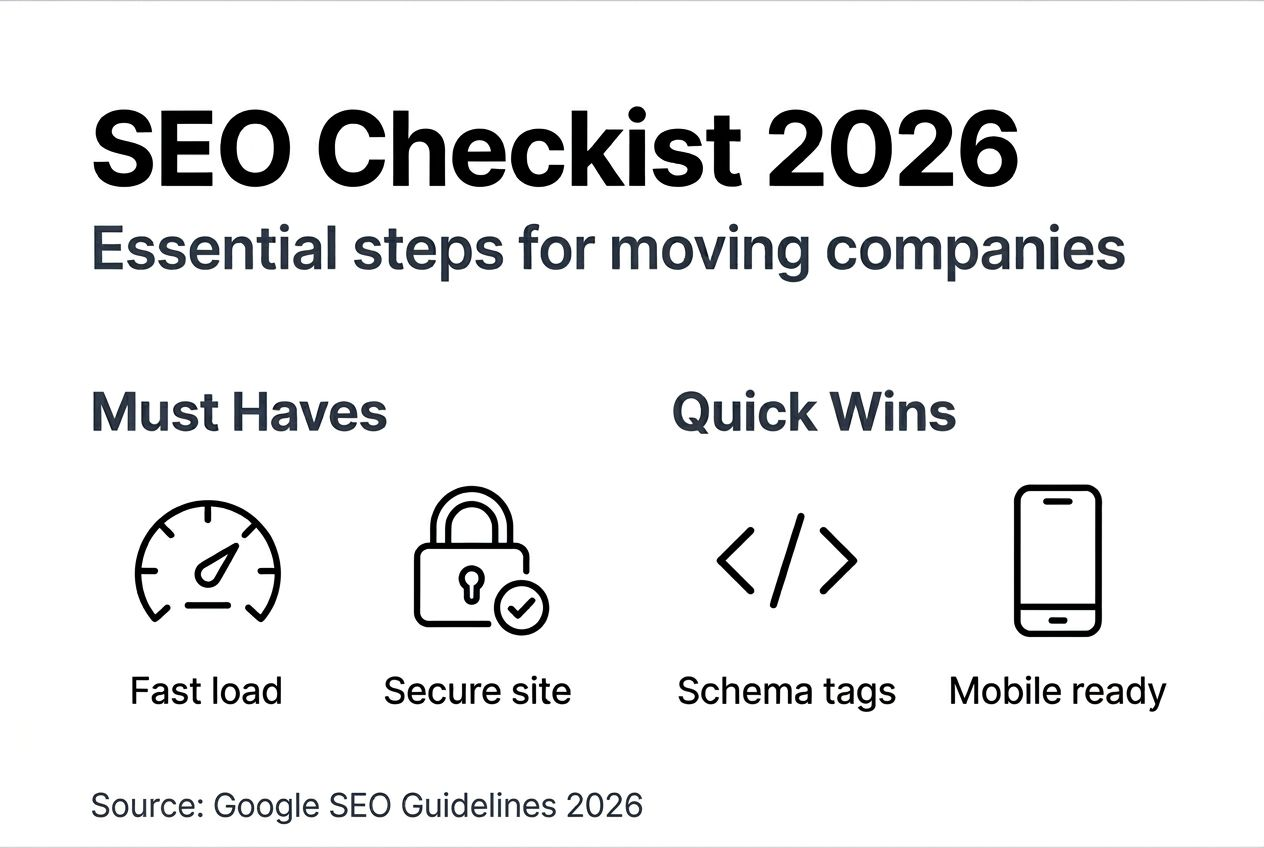
Regularly audit your site using the 2026 SEO technical checklist to catch issues before they hurt rankings. Technical problems compound over time, so quarterly reviews keep your site healthy.
Organic SEO vs paid search for moving companies: a comparison
Combining organic SEO and paid search yields 35% higher ROI than relying on one channel alone. Each approach has distinct advantages, and understanding when to use each maximizes your marketing effectiveness.
Organic SEO builds sustainable visibility over time. Once you rank well locally, you receive consistent traffic without ongoing per-click costs. It requires upfront effort but delivers compounding returns as your authority grows.
Paid search provides immediate visibility and precise targeting. Google Ads puts you at the top of results instantly for competitive keywords. You control exactly which searches trigger your ads and can adjust budgets based on seasonal demand.
| Feature | Organic SEO | Paid Search (PPC) |
|---|---|---|
| Cost Structure | Upfront investment, ongoing maintenance | Pay per click, ongoing budget required |
| Timeline to Results | 3-6 months for significant rankings | Immediate visibility when ads launch |
| Sustainability | Long-term traffic without per-visit cost | Traffic stops when budget runs out |
| Click-Through Rate | Higher CTR for organic results | Lower CTR but appears above organic |
| Trust Factor | Users trust organic results more | Some users skip ads entirely |
| Control | Limited control over rankings | Precise control over targeting and budget |
| Best For | Long-term growth and brand building | Immediate leads and seasonal campaigns |
Situations best suited for each method:
- Use organic SEO when building long-term market presence and brand authority
- Use paid search during peak moving season (May through September) for maximum lead volume
- Combine both for competitive markets where top rankings are difficult to achieve organically
- Start with paid search for immediate leads while waiting for organic efforts to mature
- Focus on organic for local markets with lower competition and clearer ranking opportunities
The most effective strategy integrates both channels. Use paid search to capture immediate demand while building organic authority. As your organic rankings improve, reduce ad spend on keywords you rank well for and shift budget to more competitive terms.
Common misconceptions in SEO for moving companies
SEO is not just keyword stuffing. Cramming keywords into content unnaturally hurts readability and rankings. Modern SEO focuses on user intent, quality content, and technical excellence. Write for humans first, optimize for search engines second.
Google Business Profile requires ongoing active management, not just one-time setup. Regularly posting updates, adding photos, responding to reviews, and updating hours keeps your profile fresh. Inactive profiles lose visibility compared to competitors who actively engage.
Paid ads complement but cannot replace organic SEO benefits. Ads stop working when you stop paying. Organic rankings build equity in your brand and provide free traffic indefinitely. Balanced strategies use both for maximum impact.
Local SEO is an ongoing process requiring consistent effort. Algorithm updates, new competitors, and changing customer behavior mean you can’t optimize once and forget it. Monthly monitoring and quarterly strategy reviews keep you competitive.
Common misconceptions corrected:
- Myth: More keywords mean better rankings. Reality: Relevance and user experience matter more than keyword density.
- Myth: SEO delivers results in weeks. Reality: Meaningful organic growth typically takes 3-6 months of consistent effort.
- Myth: Social media followers directly improve search rankings. Reality: Social signals help indirectly through brand awareness and traffic, not as direct ranking factors.
- Myth: You need a huge budget to compete locally. Reality: Strategic local SEO often outperforms larger competitors with unfocused national strategies.
- Myth: Google Business Profile optimization is all you need. Reality: It’s essential but works best combined with website SEO, content, and link building.
Understanding these realities helps you set appropriate expectations and invest in strategies that actually work for moving companies in competitive local markets.
Boost your moving company’s SEO with expert help
Implementing comprehensive SEO for moving companies requires expertise in local optimization, technical configuration, and ongoing strategy. Professional services tailored to your market accelerate results and avoid costly mistakes.
Todd Stager specializes in SEO for small businesses with deep experience in local service industries. We understand the unique challenges moving companies face competing for local visibility and can build strategies that generate qualified leads consistently.
Our approach combines technical audits, content strategy, reputation management, and link building into cohesive campaigns. We track what matters: local rankings, organic traffic, and most importantly, leads that convert into booked moves.
Ready to dominate local search in your market? Explore our tailored packages and schedule a consultation to discuss how we can grow your moving company’s online presence in 2026.
Frequently asked questions about SEO for moving companies
What is local SEO and why is it critical for moving companies?
Local SEO optimizes your online presence to attract customers in your specific service areas. It’s critical because moving services are inherently local, and customers search for nearby providers. Without local optimization, you’re invisible to high-intent searchers ready to book.
How often should I update my Google Business Profile?
Update your Google Business Profile at least weekly with posts, photos, or offers. Active profiles rank higher in local pack results and build trust with potential customers. Respond to reviews within 24 hours and update hours or services immediately when changes occur.
Can I rely only on paid ads instead of SEO?
Paid ads provide immediate leads but become expensive over time and stop working when you pause campaigns. Organic SEO builds sustainable traffic that doesn’t require ongoing per-click costs. The best approach combines both for immediate results and long-term growth.
What keywords should I target for my moving business?
Target location-specific keywords combining your services with city, neighborhood, or “near me” modifiers. Examples include “movers in [city],” “apartment moving [neighborhood],” and “long distance moving company [state].” Mix commercial intent terms with informational keywords to capture customers at different journey stages.
How do reviews impact my search rankings and customer trust?
Reviews influence both rankings and conversions significantly. Google considers review quantity, quality, and recency as local ranking factors. Positive reviews increase click-through rates and conversion rates, while negative reviews can reduce conversions by 30%. Active review management is essential for competitive local markets.