


TL;DR:
- Hospital SEO requires building authority through focused service line content rather than broad health topics. Technical SEO, local optimization, and patient-centered keyword strategies are essential for ranking and patient acquisition. Measuring actual conversions, like appointment requests, ensures SEO efforts translate into tangible healthcare growth.
Hospital marketing teams face a deceptively hard challenge. Ranking well in search requires far more than publishing health articles, and this seo for hospitals guide exists precisely to close that gap. Generic content strategies fail because hospital SEO sits at the intersection of regulatory compliance, clinical authority, and hyper-local competition. Healthcare SEO campaigns yield a median ROI of 748%, yet most hospitals leave that potential untapped by chasing broad topics instead of owning specific service line authority. What follows is the strategic framework your team needs to change that.
Key takeaways
| Point | Details |
|---|---|
| Content clusters over broad coverage | Build deep authority in specific service lines rather than publishing thin content across every health topic. |
| Technical SEO is non-negotiable | Page speed, mobile-first design, and structured data directly determine whether your hospital ranks or gets buried. |
| Local SEO drives patient acquisition | Over 80% of patients search locally, making NAP consistency and location pages mission-critical priorities. |
| Patient language beats clinical jargon | Map keywords to how patients actually search, not how clinicians speak, to attract qualified traffic. |
| Measure conversions, not just traffic | Organic traffic without patient conversion tracking tells you nothing about real business impact. |
Building content clusters around service lines
The single biggest mistake hospitals make with SEO is trying to compete with WebMD and Healthline on general health information. You will not win that battle on their turf. The smarter play is content ownership of clinical strengths rather than broad health information coverage, which means choosing the service lines where your hospital genuinely excels and building deep, interconnected content around them.
Think of a content cluster as a hub-and-spoke model. Your pillar page covers a service line at a high level, say orthopedics, and then spoke pages dig into specific conditions, procedures, recovery timelines, insurance considerations, and physician profiles. Each spoke page links back to the pillar. Every internal link passes authority, and the cluster signals to Google that your hospital is a genuine expert in that area, not just a surface-level publisher.
Here is what strong cluster architecture looks like in practice for a cardiology service line:
- A pillar page covering your hospital’s cardiac care program, credentials, and technology
- Individual pages for heart failure treatment, coronary artery disease, cardiac catheterization, and electrophysiology
- Patient education content on symptoms, risk factors, and when to seek emergency care
- Physician bio pages with detailed credentials, peer-reviewed publications, and patient outcomes data
- FAQ pages answering the questions patients type into Google at 2 a.m. before their appointment
That last point matters more than most teams realize. Google evaluates healthcare content against E-E-A-T standards, meaning credentialed provider pages with detailed information consistently outrank thin content. A cardiologist’s bio that lists board certifications, clinical specialties, hospital affiliations, and published research is not a vanity page. It is a ranking asset.
Pro Tip: Identify two or three service lines where your hospital has genuine clinical depth and regional reputation, then commit to building the most authoritative content cluster in your market for those areas before expanding.
Hospitals can outperform generic health publishers specifically in regionally relevant clinical topics. You do not need to win nationally. You need to win in your catchment area.
Technical SEO foundations for hospital websites
Content authority means nothing if your website cannot be properly crawled, rendered, or loaded quickly. Hospital websites often accumulate technical debt from years of redesigns, third-party integrations, and fragmented CMS setups. Cleaning up that foundation is where meaningful organic growth begins.
The most overlooked technical issue in hospital SEO is rendering. Many hospital websites rely heavily on JavaScript frameworks that delay content loading. Server-side rendering improves organic traffic by 27.1% by delivering fully indexed content to Google’s crawlers without waiting for client-side scripts to execute. If your site relies on JavaScript to display physician directories, appointment scheduling widgets, or service line content, you need to audit how search engines actually see those pages.
Page speed is equally critical. Pages must load under 3 seconds to meet ranking requirements and user expectations. Core Web Vitals, specifically Largest Contentful Paint, Interaction to Next Paint, and Cumulative Layout Shift, are direct Google ranking signals. Hospital homepages loaded with hero videos, stock photography, and chatbot overlays frequently fail these benchmarks without anyone noticing until organic traffic stalls.
Structured data represents one of the highest-leverage technical investments a hospital can make. Medical schema markup helps Google surface rich results like knowledge panels, physician profiles, FAQ boxes, and department-level details directly in search results. 66% of structured articles with schema markup appear as featured snippets capturing 42% of click share. Implementing MedicalOrganization, Physician, and MedicalCondition schema across your site is not optional if you want to compete in 2026.
Internal linking also deserves serious attention from a technical perspective. Many hospital websites have siloed content from different departments with no cross-linking. A well-planned internal link structure passes authority from high-traffic pages toward conversion-oriented pages, improves crawlability, and signals topical relationships to search engines.
Local SEO for patient acquisition
If you are focused on improving hospital visibility, local SEO is where the highest-intent patient searches happen. Over 80% of patients search locally, and searches like “cardiologist near me” or “emergency room in [city]” have immediate, high-stakes intent behind them. Ranking for those queries puts your hospital in front of patients who are ready to act.
Here is a practical framework for building local SEO strength:
Audit NAP consistency. Your hospital’s name, address, and phone number must be identical across your Google Business Profile, website footer, Apple Maps, Bing Places, Healthgrades, Vitals, and every local directory. Even small discrepancies like “St.” versus “Street” can suppress local rankings.
Optimize your Google Business Profile completely. This means selecting accurate primary and secondary categories, writing a keyword-rich description of your services, uploading original photos of your facility, and posting regular updates about new services, community events, or health tips.
Create unique, indexable pages for each location. A hospital system with multiple campuses must have distinct landing pages for each site, not a single page with a dropdown. Unique location pages prevent duplicate content penalties and boost local visibility by allowing each campus to rank independently for its geographic market.
Build a patient review strategy. Positive reviews on Google, Healthgrades, and Yelp function as both trust signals for prospective patients and ranking signals for local search algorithms. Train front-desk staff to ask satisfied patients for reviews and create a simple follow-up process via email or text.
Produce geo-targeted content. Write articles, news pieces, and service pages that reference your city, neighborhood, and regional health concerns. A blog post about local flu trends or a community health screening event creates local relevance that generic health content never will.
Pro Tip: Use Google Business Profile Insights to identify which search queries are driving views and actions on your listing, then create dedicated service pages that match those exact search terms.
Keyword research and patient language
SEO without intent alignment is like speaking the wrong language to the right person. Clinical terminology is how your physicians talk to each other. It is not how your patients search. Keyword research should reflect patient language, focusing on conversational and long-tail keywords that mirror how someone describes a symptom, procedure, or concern before they understand the clinical vocabulary.

Consider the patient journey for knee replacement surgery. At the informational stage, they search “knee pain won’t go away” or “when do you need knee surgery.” At the navigational stage, they search “[hospital name] orthopedics” or “best orthopedic surgeons near me.” At the transactional stage, they search “knee replacement surgery appointment” or “orthopedic surgeon accepting new patients.” Each stage requires a distinct page with content calibrated to that specific intent.
Practical steps for patient-focused keyword research include:
- Pull search queries from your Google Business Profile, Google Search Console, and internal site search to see the exact language your current visitors use
- Interview patient intake coordinators to learn the most common questions patients ask before scheduling
- Use autocomplete data from Google and symptom-based search platforms to surface question-based keywords
- Build landing pages that combine location, specialty, and insurance terms, for example “knee replacement surgery covered by Medicare in Chicago”
- Review competitor gap analysis to find high-volume queries where existing content ranks below page two
First-party data from your analytics and CRM is one of the most underused assets in digital marketing for hospitals. You already know what patients are calling about. Map that to search behavior and you will find your most valuable keyword opportunities.
Measuring SEO results that actually matter
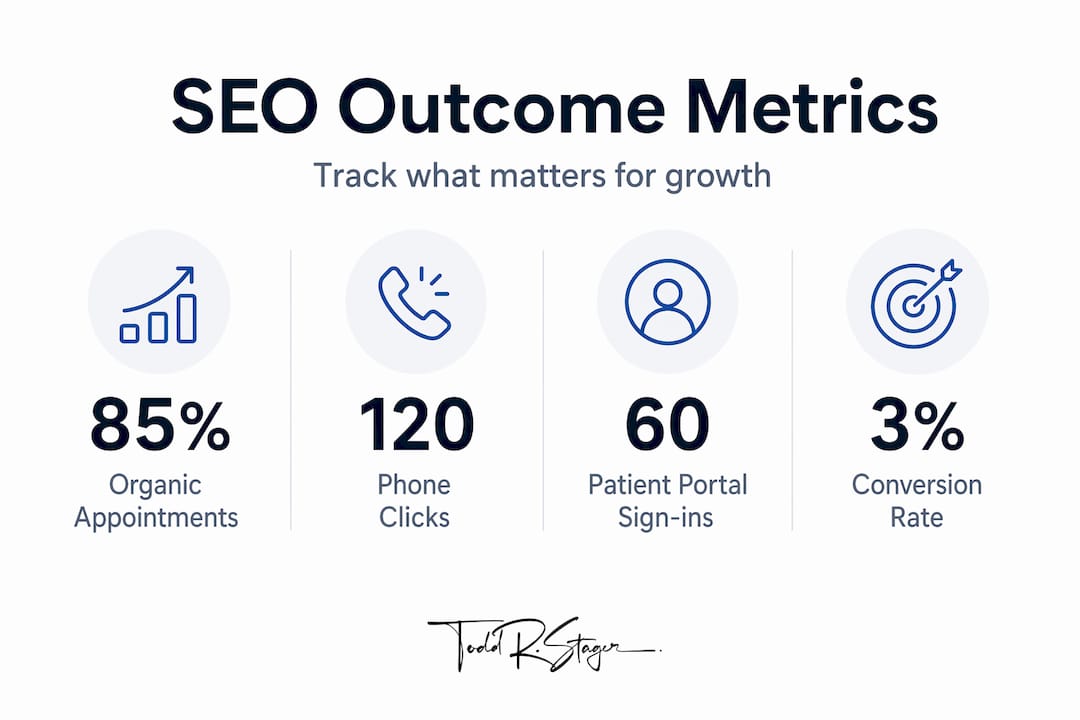
Traffic is not a business result. It is a precursor to one. The most financially accountable hospital marketing teams measure SEO by patient acquisition, appointment requests, and conversion rate by service line, not by session counts or keyword volume.
| Metric | What it actually measures | Recommended tool |
|---|---|---|
| Organic appointment requests | Direct patient conversion from SEO | Google Analytics 4 with goal tracking |
| Keyword ranking by service line | Search visibility in clinical focus areas | Google Search Console |
| Local pack appearance rate | Local SEO reach for geographic searches | Google Business Profile Insights |
| Engagement rate by page | Content quality and intent match | Google Analytics 4 |
| Share of voice vs. competitors | Overall SEO market position | SEO tracking platforms |
Tracking SEO performance by patient conversions rather than traffic alone yields insights that actually shape strategy. If your orthopedics service line generates 40% of your organic traffic but only 8% of appointment form completions, you have a conversion problem on that set of pages, not an SEO problem.
Set up event tracking in Google Analytics 4 for every conversion touchpoint: appointment form submissions, phone number clicks, direction requests, and patient portal sign-ins. Cross-reference that data with keyword ranking movement to identify which hospital SEO strategies are producing real patient volume.
My perspective on where hospital SEO goes wrong
I’ve worked with healthcare marketing teams at every level of sophistication, and the most consistent mistake I see is prioritizing content volume over content depth. Teams publish dozens of general articles about common conditions because it feels productive. But ranking a generic article about hypertension against established health publishers is a near-impossible uphill effort, and even if you manage it, the patient who lands on that page likely is not looking for your specific hospital.
What I’ve found actually works is the opposite instinct. Narrow your focus dramatically. Pick the two or three service lines that define your hospital’s regional reputation, then build the most thorough, medically credible content on the internet for those specific areas. That approach builds the kind of deep content authority that moves the needle on patient acquisition, not just impressions.
I’ve also seen too many hospitals treat technical SEO as a one-time website launch task. Page speed degrades. Schema markup gets broken during CMS updates. Mobile experience gets compromised by third-party widgets. A strong technical SEO foundation requires quarterly audits and ongoing attention. The hospitals that rank consistently are the ones that treat technical performance as a maintenance discipline, not a project.
Local SEO is the most underestimated piece in most hospital marketing plans. The patients most likely to choose your hospital are searching within a 10 to 15 mile radius of your location. Owning that local search territory through optimized listings, unique location pages, and authentic patient reviews will deliver faster, more measurable returns than almost any other SEO investment.
— TODD
How Toddstager helps hospitals grow with SEO
Hospital SEO is genuinely complex. It requires the intersection of technical precision, clinically credible content, local authority building, and rigorous measurement. Most hospital marketing teams are stretched thin managing day-to-day communications and campaigns without the bandwidth to execute a multi-layered SEO program consistently.
Toddstager specializes in SEO for medical professionals and has developed deep expertise in the unique demands hospital websites face, from E-E-A-T compliance and structured data implementation to local pack optimization and service line content strategy. Whether you are starting from a weak technical foundation or looking to expand a working SEO program, Toddstager brings the focused expertise that healthcare organizations need to compete. The same specialized approach extends across healthcare, including dental practice SEO, so you get a team that understands the full patient acquisition picture. Reach out to Toddstager to discuss a customized hospital SEO strategy built around your clinical strengths and growth goals.
FAQ
What is the most important SEO priority for hospitals?
Building deep content clusters around your strongest service lines, combined with a technically sound website and consistent local SEO, delivers the highest return. Google rewards depth and clinical authority, not broad coverage.
How does local SEO help hospitals attract patients?
Over 80% of patients search within a geographic area before choosing a provider, making local pack rankings and optimized Google Business Profiles a direct channel to high-intent patients.
What keywords should hospital websites target?
Focus on conversational, long-tail keywords that reflect how patients describe symptoms and conditions, not clinical terminology. Map those keywords to each stage of the patient decision journey for best results.
How do you measure hospital SEO success?
Track appointment form submissions, phone click-throughs, and patient portal sign-ins from organic traffic rather than session counts alone. Conversion-focused measurement connects SEO performance directly to patient acquisition outcomes.
Why does technical SEO matter so much for hospital websites?
Hospital sites often carry heavy JavaScript loads, slow image assets, and fragmented CMS structures that hurt crawlability and speed. Server-side rendering, Core Web Vitals compliance, and medical schema markup are each direct ranking factors that determine whether your content gets found.