


TL;DR:
- SEO return on investment measures the profit generated from SEO spending, typically over 12 to 24 months. Accurate measurement involves tracking organic revenue, conversion rates, costs, and lifetime value, using tools like GA4 and Semrush. Proper evaluation shows that SEO can yield returns exceeding 700%, emphasizing patience and comprehensive attribution for success.
SEO return on investment (ROI) is defined as the percentage of profit your SEO spending generates, calculated with this formula: (Revenue from SEO minus Cost of SEO) divided by Cost of SEO, multiplied by 100. If you spend $5,000 on SEO and generate $25,000 in revenue, your SEO ROI equals 400%. That single number tells you whether your SEO investment is paying off or draining your budget. Tools like Google Analytics GA4 and Semrush make calculating SEO ROI far more precise than guesswork. The average SEO ROI across industries sits around 748% over 12–24 months, which means the benefit of SEO investment compounds significantly when you give it time to mature.
How to measure SEO ROI: the metrics that matter

Accurate SEO ROI measurement starts with tracking the right data points. Without clean inputs, the formula produces a meaningless number.
Here are the core metrics you must track:
- Organic traffic volume and quality. Monitor total organic sessions in Google Analytics GA4, but also segment new versus returning visitors. High returning visitor rates from organic search often signal strong brand recall and content authority.
- Organic conversion rate. Track what percentage of organic visitors complete a desired action, whether that is a purchase, a form submission, a phone call, or a sign-up. This is the bridge between traffic and revenue.
- Revenue attributed to organic search. Use channel grouping in GA4 to isolate organic search revenue from paid, direct, and referral traffic. Mixing channels produces inflated or deflated ROI figures.
- Total SEO costs. Add up every dollar spent: agency or freelancer fees, SEO tools like Semrush or Ahrefs, content creation, technical audits, and your own time valued at an hourly rate. Underestimating costs is the most common way small businesses overstate their ROI.
- Customer Lifetime Value (CLV). A single sale understates SEO’s true return for businesses with repeat customers. A landscaping company that earns $300 from a first job but $2,400 over three years from that same client should use CLV in its ROI calculation, not just the initial transaction.
Tracking organic conversion rate alongside revenue gives you a complete picture of measuring SEO effectiveness. Traffic without conversions is just a vanity metric wearing a business suit.
Step-by-step: how to calculate SEO ROI
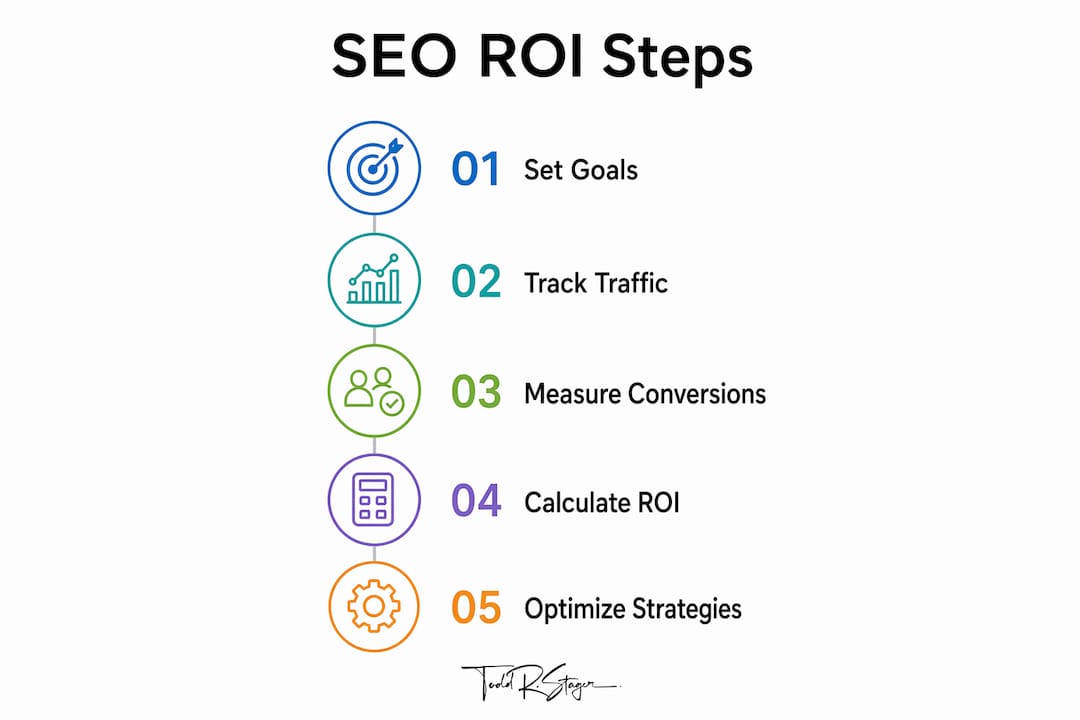
Follow these steps to move from raw data to a reliable ROI figure.
Set up conversion tracking in Google Analytics GA4. Define every meaningful conversion event: purchases, contact form submissions, phone call clicks, and newsletter sign-ups. GA4’s data-driven attribution distributes conversion credit across multiple touchpoints, which is far more accurate than last-click models that ignore the role of organic content in the buyer journey.
Calculate your total SEO costs. Add agency fees, tool subscriptions, content costs, and internal labor for the measurement period. Be thorough. A $1,500 monthly retainer plus $200 in tools plus 10 hours of your time at $75 per hour equals $2,450 in true monthly SEO cost.
Pull organic revenue from GA4. Filter your revenue report by the organic search channel. For lead-based businesses, assign a dollar value to each lead using your average close rate and average deal size.
Apply the ROI formula. Plug your numbers in: (Revenue from SEO minus Cost of SEO) divided by Cost of SEO, multiplied by 100.
Use the Traffic Value Method as a secondary check. This method estimates what your organic traffic would cost if you bought it through Google Ads. Multiply your monthly organic sessions by the average cost-per-click for your target keywords. Traffic value validates SEO impact in situations where direct revenue tracking is difficult, such as informational content that drives brand awareness.
Compare your organic cost-per-acquisition (CPA) to paid CPA. Organic CPA can be three times more efficient than paid search CPA once SEO reaches maturity. This comparison is persuasive evidence for stakeholders who question the benefit of SEO investment.
Here is a simple ROI calculation example:
| Metric | Value |
|---|---|
| Monthly organic revenue | $18,000 |
| Monthly SEO cost | $3,000 |
| Net SEO profit | $15,000 |
| SEO ROI | 500% |
| Equivalent paid traffic value | $9,500 |
Pro Tip: Set your GA4 conversion goals before you launch any SEO campaign. Retroactive tracking misses early data and makes your first-year ROI look worse than it actually is.
What are the biggest mistakes in measuring SEO ROI?
Most small businesses get SEO ROI wrong not because the math is hard, but because they measure at the wrong time with the wrong metrics.
- Measuring too early. Healthy SEO ROI is typically evaluated over 12–24 months because content authority and technical health build gradually. Checking ROI at month three is like judging a crop yield in the first week after planting.
- Relying on vanity metrics. Keyword rankings and impressions feel good but do not pay bills. SEO reporting should center on organic revenue and conversion rate, not position tracking alone.
- Improper attribution. If your GA4 channel grouping is misconfigured, organic traffic gets lumped into direct or referral buckets. You end up crediting SEO for less than it actually drives.
- Ignoring ongoing maintenance costs. SEO is not a one-time project. Monthly content updates, technical fixes, and link building are real costs. Leaving them out of your calculation inflates ROI and sets false expectations.
Premature ROI measurement is one of the leading reasons businesses cut effective SEO campaigns early, according to industry experts. SEO requires building content authority and technical health, processes that mature slowly. Cutting a campaign at month four because ROI looks flat is like canceling a gym membership the week before results appear.
You can learn more about tracking SEO performance for service businesses to avoid these attribution errors from the start.
Which tools make SEO ROI measurement easier?
The right tools remove the manual work from ROI tracking and surface the numbers you actually need.
Google Analytics GA4 is the foundation. It tracks organic sessions, conversion events, and revenue by channel at no cost. Its data-driven attribution model is the most accurate free option available for small businesses.
Semrush adds competitive context. You can pull keyword difficulty scores, estimated traffic values, and backlink data that feed directly into your ROI calculations. Its organic traffic cost report shows what your current rankings would cost in paid ads.
BrightEdge offers enterprise-level SEO ROI calculators that forecast revenue impact from ranking improvements. It is better suited to larger marketing teams, but its methodology is worth understanding even if you use simpler tools.
For link building ROI specifically, the Lifetime Link Value framework calculates return by multiplying the monthly traffic value of a linking root domain by 24 months. This framework gives a monetary estimate of link building efforts that goes beyond short-term revenue snapshots.
Here is a comparison of the primary tools:
| Tool | Best For | Monthly Cost | Ease of Use |
|---|---|---|---|
| Google Analytics GA4 | Revenue and conversion tracking | Free | Moderate |
| Semrush | Keyword and traffic value analysis | From $139.95 | Moderate |
| BrightEdge | Enterprise ROI forecasting | Custom pricing | Advanced |
Pro Tip: Connect Semrush to GA4 using the Google Analytics integration inside Semrush. This pulls organic session data alongside keyword rankings, so you can see which specific keywords are driving revenue, not just traffic.
For a broader look at SEO services for small businesses, understanding which service types affect your investment and ROI helps you allocate budget more precisely.
How do you report SEO ROI to stakeholders?
Reporting SEO ROI clearly is as important as calculating it correctly. A number without context rarely changes minds or protects budgets.
Follow these reporting best practices:
- Lead with business outcomes. Open every report with organic revenue, leads generated, and cost-per-acquisition. Save rankings and impressions for the appendix.
- Use trend lines, not snapshots. A single month of data is noise. Show a 6-month or 12-month trend line to demonstrate the compounding nature of SEO growth.
- Explain your attribution model. Tell stakeholders whether you are using last-click, data-driven, or linear attribution. Transparency about assumptions builds credibility.
- Compare SEO CPA to paid CPA. Showing that organic leads cost one-third of paid leads is the most persuasive argument for continued SEO investment.
- Tailor the depth to your audience. A CFO wants revenue and cost efficiency. A marketing director wants channel performance and keyword trends. The same data, presented differently, lands with very different impact.
Good SEO reporting for small businesses builds the internal trust that keeps SEO budgets intact through slow growth periods.
Key takeaways
Measuring SEO ROI accurately requires the right formula, clean attribution data, and a 12–24 month evaluation window to capture SEO’s full compounding return.
| Point | Details |
|---|---|
| Use the correct formula | Calculate (Revenue minus Cost) divided by Cost times 100 for a true ROI percentage. |
| Track the right metrics | Organic revenue, conversion rate, and CPA matter more than rankings or impressions. |
| Give SEO time to mature | Evaluate ROI over 12–24 months; industry average ROI reaches around 748% at that horizon. |
| Account for all costs | Include tools, agency fees, content, and your own time to avoid overstating returns. |
| Use GA4 data-driven attribution | Distribute conversion credit across touchpoints for a more accurate picture of SEO’s role. |
The honest truth about SEO ROI measurement
I’ve worked with small business owners across dozens of industries, from HVAC contractors to dental practices, and the pattern I see most often is this: they measure SEO ROI too early, get discouraged, and pull the budget right before the compounding kicks in.
The businesses that win with SEO treat it the way a smart investor treats a diversified portfolio. They check performance regularly, but they do not panic-sell at the first dip. I’ve watched a roofing company go from zero organic leads to 40 per month between months 8 and 14. Their ROI at month 6 looked terrible. By month 18, it was the most efficient channel in their marketing mix.
What I’ve also learned is that ROI alone is not the full story. Layering in metrics like dwell time, engagement rate, and intent match gives you a richer picture of whether your content is building real authority or just ranking for low-intent queries. A page that ranks for “what is a roof inspection” and converts at 0.2% is not the same asset as a page ranking for “roof inspection cost near me” converting at 4%.
The clients who trust the process are the ones who get the results. Transparent reporting, honest timelines, and a focus on revenue over rankings. That combination is what separates SEO that grows a business from SEO that just looks busy.
— TODD
Ready to measure and maximize your SEO ROI?
Knowing the formula is step one. Getting the results requires an SEO strategy built around your specific industry, your customers’ search behavior, and your revenue goals.

Toddstager builds ROI-focused SEO programs for small businesses across industries, from landscaping companies to restaurants to manufacturers. Every engagement starts with a clear baseline, defined conversion goals, and a reporting framework so you always know what your SEO is returning. If you are ready to move from guessing to measuring, Toddstager is the partner that makes that shift straightforward.
FAQ
What is the SEO ROI formula?
The standard formula is (Revenue from SEO minus Cost of SEO) divided by Cost of SEO, multiplied by 100. Spending $5,000 and generating $25,000 in organic revenue equals a 400% ROI.
How long does it take to see a positive SEO ROI?
Most businesses should evaluate SEO ROI over 12–24 months. The industry average reaches around 748% at that horizon, but early months often show flat or negative returns as content authority builds.
What tools do i need to track SEO ROI?
Google Analytics GA4 is the starting point for revenue and conversion tracking. Semrush adds keyword and traffic value data that strengthens your ROI calculations without requiring enterprise-level budgets.
Why is organic CPA better than paid CPA?
Organic CPA can be up to three times more efficient than paid search CPA once SEO matures. Unlike paid ads, organic rankings continue generating traffic without a per-click cost.
What metrics should i avoid when reporting SEO ROI?
Avoid leading with keyword rankings, impressions, or raw traffic numbers. These vanity metrics do not reflect business outcomes. Focus on organic revenue, conversion rate, and cost-per-acquisition instead.