


Publishing a blog post every week and wondering why the phone still isn’t ringing? You’re not alone. Many small service business owners pour time into content without a clear SEO strategy, then blame content marketing when leads don’t come. The real issue isn’t the content itself. It’s the missing connection between what you write and how search engines find and rank it. Content marketing generates 3x more leads at 62% less cost than traditional advertising, with ROI appearing in as little as 4-6 months for small businesses. The businesses winning online aren’t publishing more. They’re publishing smarter.
Key Takeaways
| Point | Details |
|---|---|
| SEO and content work together | Great content needs SEO to be discovered and SEO is most effective when paired with valuable content. |
| Local pages are critical | Service businesses should prioritize geo-targeted service pages and case studies for fast impact. |
| ROI is proven and measurable | Most service businesses see significant returns within six months of smart content marketing SEO. |
| Strategy beats quantity | A focused strategy with search intent mapping and content clusters outperforms random blogging or keyword stuffing. |
What is content marketing SEO?
Content marketing SEO is the practice of creating valuable, relevant content specifically designed to rank in search engines and convert readers into customers. It’s not just blogging. It’s not just keyword stuffing. It’s a deliberate strategy that combines two powerful forces.
SEO handles discoverability. It tells search engines what your pages are about, who should see them, and why your site deserves to rank. Content handles engagement. It answers questions, builds trust, and moves visitors toward booking your service. As SEO drives discoverability while content ensures engagement and conversions, neither works as well without the other.
Think of it this way: SEO is the map that gets people to your door, and content is the experience that makes them walk in and stay. A map with no destination is useless. A destination with no map stays empty.
Here’s what a strong content marketing SEO approach delivers for service businesses:
- Higher organic rankings on Google for service-related searches
- More qualified leads who already understand what you offer
- Reduced dependence on paid ads over time
- Stronger audience trust before the first phone call
- Local authority in your specific service area
“The best content marketing doesn’t feel like marketing. It feels like the answer to a question your customer was already asking.”
A well-built content marketing strategy ties every piece of content to a specific business goal, whether that’s ranking for a local keyword, generating a quote request, or building brand recognition in your city.
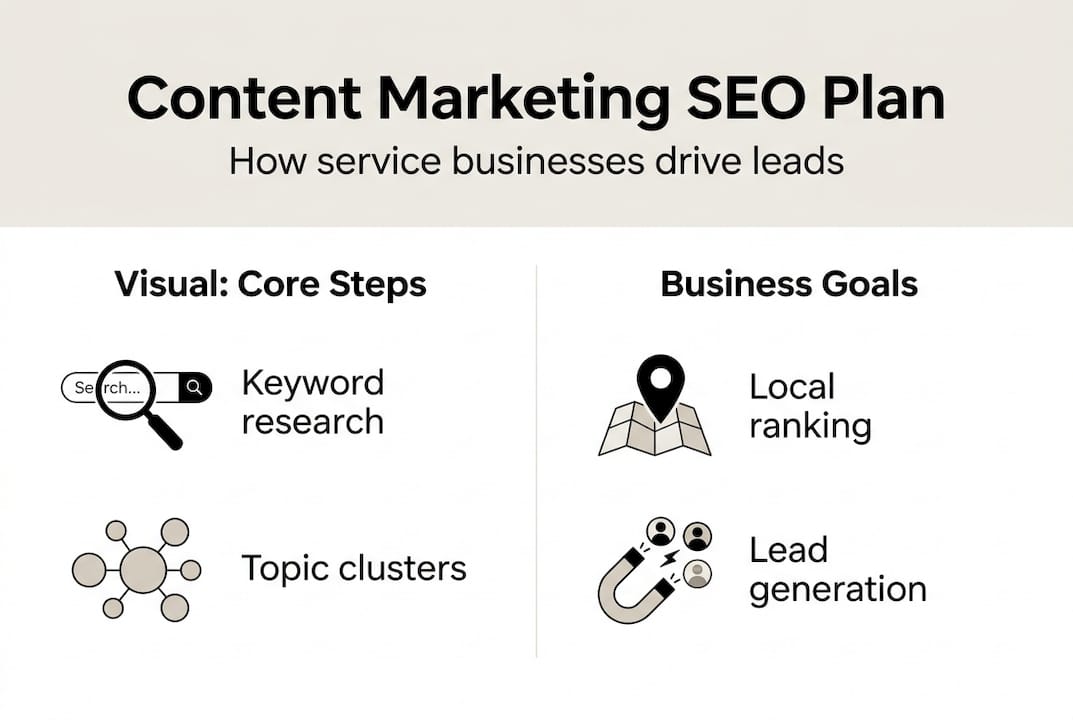
Core principles: How content marketing SEO works
Knowing the pieces fit together is one thing. Understanding the mechanics is what separates businesses that grow from those that spin their wheels. The core methodologies include topic cluster models, search intent mapping, keyword research, internal linking, and on-page SEO.
Keyword research is the foundation. You need to know exactly what your potential customers type into Google before they hire a plumber, landscaper, or chiropractor. Tools like Google Search Console and free keyword planners reveal real search volume and competition levels.

Topic clusters organize your content so Google understands your expertise. One strong pillar page covers a broad topic, and several supporting pages link back to it.
| Content type | Purpose | Example |
|---|---|---|
| Pillar page | Covers a broad service topic | “HVAC services in Dallas” |
| Cluster page | Covers a specific subtopic | “AC repair cost in Dallas” |
| Blog post | Answers a specific question | “Why is my AC blowing warm air?” |
| Case study | Builds trust with real results | “How we cut energy bills by 30%” |
Search intent is about matching your content to what the searcher actually wants. There are three types you need to know:
- Informational intent: The person wants to learn. Example: “How does roof flashing work?”
- Commercial intent: The person is comparing options. Example: “Best roofing companies in Phoenix.”
- Transactional intent: The person is ready to hire. Example: “Emergency roofer near me.”
Matching the right content type to the right intent is what turns traffic into leads. Explore effective SEO content formats to see which formats work best for each intent type.
On-page SEO basics include writing descriptive title tags, adding schema markup (structured data that helps Google understand your content), writing clear meta descriptions, and using header tags correctly. These aren’t optional extras. They’re the signals Google uses to decide where you rank.
Internal linking connects your pages so both users and search engines can navigate your site logically. Every new page you publish should link to at least one other relevant page on your site.
Why content marketing SEO matters for service businesses
Service businesses live and die by local reputation and discoverability. You’re not selling a product someone can find on Amazon. You’re selling trust, expertise, and availability in a specific location. That’s exactly where content marketing SEO shines.
When you publish a detailed guide about roof replacement costs in your city, you’re not just creating content. You’re positioning yourself as the local expert before a prospect ever calls a competitor. That’s what local authority means: being the most credible, visible option in your service area.
The numbers back this up. Small businesses see ROI in 4-6 months, generating 3x more leads at 62% less cost than traditional advertising. For a service business spending $1,000 per month on Google Ads, shifting even part of that budget toward content SEO can dramatically reduce cost per lead over time.
Here’s what integrated content and SEO delivers specifically for service businesses:
- More qualified traffic: People searching for your exact service in your city
- Lower cost per lead: Organic traffic doesn’t charge per click
- Trust before contact: Prospects read your content before they call
- Compounding returns: A page published today can generate leads for years
For a deeper look at how to turn traffic into booked jobs, the SEO lead generation guide breaks down the full funnel. You can also explore the SEO service types that make the most sense for your business model.
Pro Tip: Use Google Analytics and Google Search Console together. Track which pages bring in the most organic visitors, then check if those visitors are converting into contact form submissions or calls. That’s your real ROI signal.
Building a content marketing SEO strategy: Step by step
A strategy without a process is just a wish list. Here’s a practical framework you can start using this week.
- Audit your existing content. List every page and blog post on your site. Note which ones rank, which ones get traffic, and which ones do nothing. This tells you where to improve before creating anything new.
- Set specific goals. “Get more leads” isn’t a goal. “Rank in the top 3 for ‘carpet cleaning in Denver’ within 6 months” is a goal. Specific targets drive specific actions.
- Research keywords. Focus on service plus location combinations first. Then add question-based keywords your customers actually ask.
- Map topics to search intent. Assign each keyword to the right content type based on whether the searcher wants to learn, compare, or hire.
- Build a content calendar. Plan one to two pieces per month minimum. Consistency matters more than volume.
- Publish and promote. Share new content on Google Business Profile, social media, and in email newsletters to accelerate early traffic.
Local optimization is non-negotiable for service businesses. Use geo-modifiers throughout your pages. That means city names, neighborhood names, and regional terms woven naturally into your headings, body text, and image alt tags. A landscaper in Austin who targets “lawn care Austin TX” and “landscaping Barton Hills” will outrank a competitor with generic content every time.
For small service businesses, prioritizing service pages, using geo-markers, publishing case studies, and applying E-E-A-T strategies (Experience, Expertise, Authoritativeness, Trustworthiness) are the fastest paths to local rankings. A landscaping company in Austin used exactly this approach and boosted local rankings by 144% within eight months by combining location-specific service pages with before-and-after project case studies.
For proven frameworks built specifically for your industry, the service industry SEO strategies resource and the SEO campaign process guide walk you through execution step by step.
Pro Tip: Start with your two or three most profitable services. Build a strong pillar page and two supporting pages for each before expanding to other topics. Depth beats breadth in the early stages.
Common challenges and biggest opportunities for service businesses
Most service businesses make the same handful of mistakes. Knowing them in advance saves you months of wasted effort.
| Common mistake | High-impact alternative |
|---|---|
| Only publishing generic tips blogs | Creating location-rich service pages |
| Ignoring on-page SEO basics | Optimizing every title, header, and meta description |
| Skipping internal links | Connecting every new page to existing content |
| No case studies or real examples | Publishing project results with photos and numbers |
| Targeting broad national keywords | Focusing on local and neighborhood-level terms |
Real case studies and E-E-A-T signals help service businesses build trust and rank locally. Google rewards content that demonstrates real-world experience, not just generic advice.
The biggest opportunities for service businesses right now include:
- Local keyword gaps: Many competitors haven’t optimized for neighborhood-level searches. That’s low-hanging fruit.
- Staff expertise content: Feature your team’s credentials, certifications, and project experience. This builds E-E-A-T and differentiates you from faceless competitors.
- Video and image-rich content: Service businesses have a visual advantage. Before-and-after photos, project walkthroughs, and short videos outperform text-only pages.
- FAQ pages targeting voice search: More customers are asking Google questions out loud. FAQ-style content captures those searches.
Understanding how service vs. e-commerce SEO differs helps you avoid applying the wrong tactics to your business model. Service SEO is about local trust and intent. E-commerce SEO is about product discovery and transaction volume. They require different approaches.
How to measure success and adjust your approach
You can’t improve what you don’t measure. The good news is that tracking content marketing SEO performance doesn’t require expensive software or a data analyst.
Here are the key metrics to watch:
- Organic traffic: How many visitors arrive from Google searches each month
- Keyword rankings: Which positions your target keywords hold in search results
- Lead volume: How many contact forms, calls, or quote requests come from organic traffic
- Conversion rate: What percentage of organic visitors take a desired action
- Bounce rate: Whether visitors are engaging with your content or leaving immediately
Google Analytics and Google Search Console are free and cover most of what you need. Search Console shows which keywords bring traffic and which pages get impressions. Analytics shows what visitors do once they arrive.
Early signs you’re on the right track include rising impressions in Search Console, pages moving from page 3 to page 2, and a slow but steady increase in organic sessions month over month. Don’t panic if results feel slow in the first 60 days. Content SEO is a compounding investment.
ROI averages $7.65 per $1 spent on content marketing, and most businesses can track meaningful results within a few months of consistent effort. When a page underperforms, update it with fresher information, stronger keywords, and better internal links before creating something new. Improving existing content often outperforms publishing from scratch.
For a full breakdown of what SEO can do for your specific business type, SEO for small businesses covers the complete picture.
Get expert SEO support for your service business
If you’ve read this far, you understand the value of combining content marketing with SEO. Putting it all into practice while running a service business is a different challenge entirely.
At Todd Stager, we specialize in SEO built specifically for service industry businesses across the USA. Whether you’re a plumber, chiropractor, landscaper, or contractor, we build strategies around your services, your location, and your growth goals. From SEO services for small businesses to sector-specific campaigns, we handle the technical and content work so you can focus on delivering great service. Explore how service vs. e-commerce SEO applies to your model, then reach out for a custom audit and plan tailored to your business.
Frequently asked questions
How long does content marketing SEO take to show results for small service businesses?
Most small businesses start seeing measurable ROI in 4-6 months, with lead growth and higher search rankings building steadily from there.
Should I focus on blogging or service pages for better SEO?
Service pages come first, then expand with blogs and case studies to build topical authority around your core offerings.
What’s the difference between search intent types?
Informational means the searcher wants to learn, commercial means they’re comparing options, and transactional means they’re ready to hire or book a service.
How do I make my service business content more trustworthy for Google?
Include real project examples, staff credentials, and detailed service descriptions to build E-E-A-T and local authority that Google rewards with higher rankings.